

Whole-Home Backup Without the Panel Upgrade: How MyGrid 10K Gen 2 Turns a Battery Into an Electricity Saver
The State of Home Energy Reliability
Homeowners are facing two power problems at once. Outages are becoming more disruptive, especially for people who work remotely, rely on medical equipment, or have food and temperature-sensitive items to protect. At the same time, utility bills are increasingly shaped by time-of-use pricing, with electricity costing more during high-demand hours.
A traditional standby generator solves the first problem but may sit unused for most of the year. A portable power station can keep a few devices running but usually requires extension cords and manual setup. The MyGrid 10K Gen 2 takes a different approach: it combines high-output battery backup with expandable storage and daily energy shifting. Instead of waiting for an outage, a homeowner can use stored energy during expensive rate periods and reserve some capacity for emergencies.
Why Now: Redundancy and Thermal Management
The appeal is straightforward for a household that loses power several times a year: maintain redundancy without adding fuel, engine noise, or routine generator maintenance. A battery system can switch to backup power quickly, keep refrigerators and internet equipment running, and support a home office without the homeowner going outside to start an engine.
But “whole-home” does not mean every appliance can run at the same time. The MyGrid 10K Gen 2 is rated for 10,000 watts of continuous output and up to 20,000 watts of peak output. That is substantial, but it is still a finite power budget. A refrigerator, freezer, furnace blower, Wi-Fi equipment, lights, televisions, and several rooms of receptacles may fit comfortably when their startup surges are managed.
Central air conditioning, an electric dryer, an electric water heater, an induction range, and an EV charger are different. Running several of those high-demand loads simultaneously can exceed a 10 kW inverter. Load management or a second unit may be necessary.
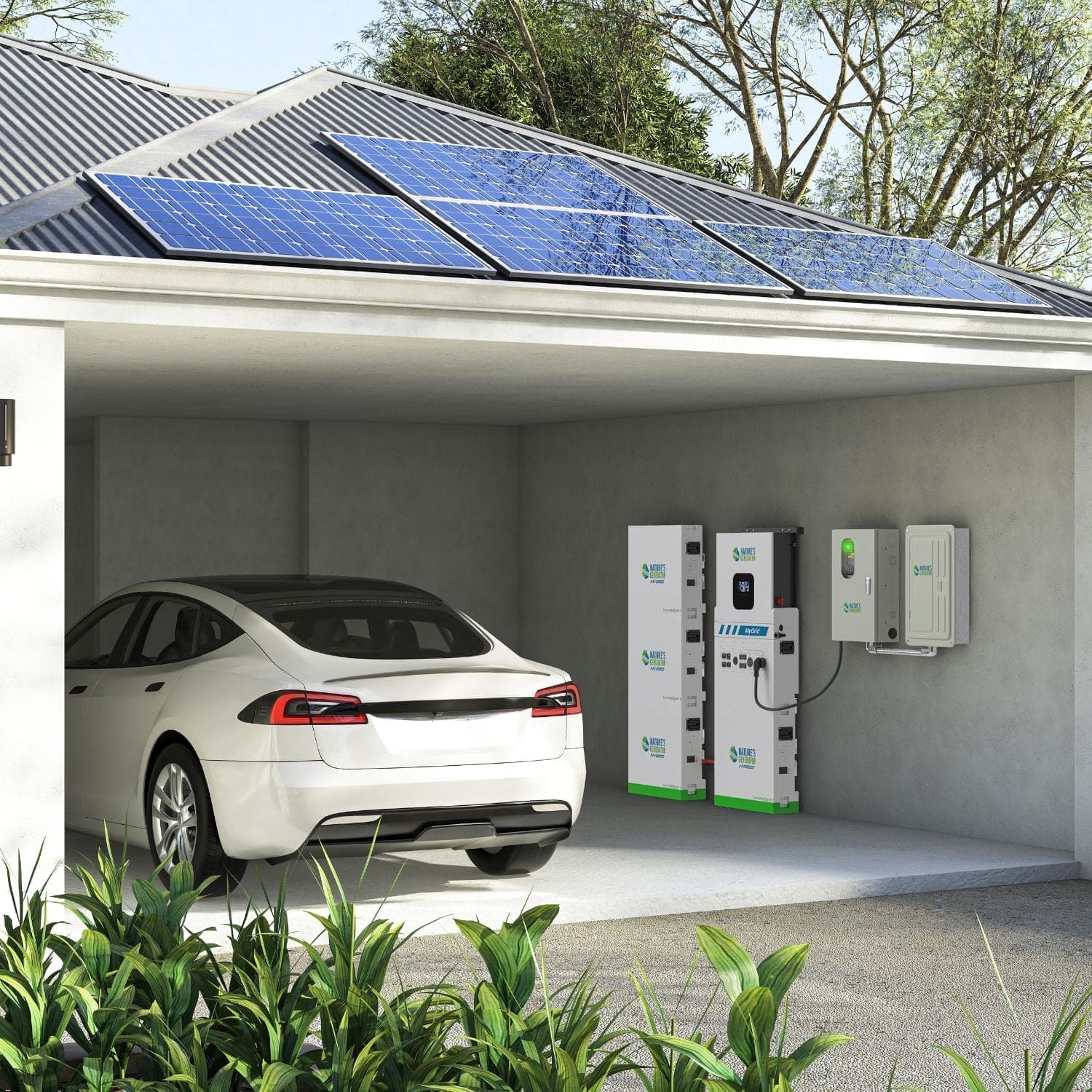
Thermal management also matters. The MyGrid 10K Gen 2 uses a LiFePO4 battery. The manufacturer lists an optimal operating range of approximately 68–86°F, with battery charging specified from 32–113°F and discharging from 14–113°F. A garage may be suitable in some climates, but the space still needs ventilation and protection from excessive heat, freezing conditions, moisture, and direct sunlight. Battery performance and charging speed can change outside the optimal range.
What a 10 kW Home Battery Can Actually Run
The most important distinction is between watts and kilowatt-hours:
- Watts (W) measure how much power appliances need at one moment.
- Kilowatt-hours (kWh) measure how much energy the battery stores over time.
The MyGrid 10K Gen 2 includes a battery rated at 10,496 watt-hours, or about 10.5 kWh. Its 10,000-watt rating describes the maximum output rate, not how long the battery will run.
Actual runtime depends on the average load, inverter losses, reserve settings, and whether appliances cycle on and off. As a simple illustration:
| Average household load | Approximate runtime from 10.5 kWh |
|---|---|
| 500 watts | 16–18 hours |
| 1,000 watts | 8–9 hours |
| 2,000 watts | 4–5 hours |
| 5,000 watts | About 1.5–2 hours |
These are planning estimates, not guarantees. Refrigerators and furnaces do not draw their maximum power continuously, while motor-driven appliances may require additional starting power.
The system provides 120/240V split-phase output and can support certain 240V loads. It also lists a pure sine wave output and automatic switching of less than 20 milliseconds in compatible configurations. That can be useful for a remote worker whose router, monitor, and computer cannot tolerate a long interruption.
However, the exact transfer equipment matters. The MyGrid 10K Gen 2 product page lists both automatic-transfer capability and configurations using a manual transfer switch. The electricity-saver bundle specifically includes a 50A manual transfer switch. That means buyers should not assume every package provides automatic whole-home transfer. Confirm the exact model, wiring method, and transfer behavior before purchase.
How the MyGrid 10K Gen 2 Can Save Electricity
A battery that only operates during outages is an insurance policy. A battery that charges and discharges every day can also become an energy-management tool.
Consider a household on a time-of-use rate:
- The battery charges from solar or during lower-cost overnight hours.
- The home uses stored energy during the utility’s higher-cost afternoon or evening period.
- The system recharges during the next low-cost window.
- A reserve remains available for an outage.
For example, suppose a household shifts 8 kWh per day from a peak period priced at $0.35 per kWh to an off-peak period priced at $0.15 per kWh. The gross difference is $1.60 per day. After accounting for charging and inverter losses, the usable savings may be closer to $1.30–$1.45 per day.
At that rate, annual savings could approach $475–$530 before maintenance, financing, utility changes, and battery degradation. A system costing several thousand dollars could have a simple energy-only payback of roughly 8–12 years, depending on installation cost, local rates, solar production, and how consistently the battery is used. Backup value is additional, but it should not be disguised as guaranteed bill savings.
The manufacturer advertises savings of up to 70% in some configurations. Treat that as a best-case marketing estimate, not a universal result. Your utility tariff and household load determine the actual economics.
The Home Backup Roadmap
1. List the loads you genuinely need
Start with the appliances that protect health, food, work, and basic comfort:
- Refrigerator and freezer
- Furnace blower or selected HVAC equipment
- Internet modem, router, and networking equipment
- Home office equipment
- Lighting
- Sump pump or well pump
- Garage door opener
- A limited number of kitchen and bedroom receptacles
Then identify loads you can delay or turn off, such as dryers, electric water heaters, pool pumps, EV chargers, and large air-conditioning systems. A qualified installer should calculate running and starting watts rather than relying on appliance labels alone.
2. Check the panel and transfer equipment
A panel upgrade may not be required simply to charge the MyGrid system from a standard 120V outlet. But that does not automatically make the existing electrical system suitable for whole-home backup.
Confirm:
- Service voltage and amperage
- Panel brand, model, and available breaker space
- Whether the system will feed the main panel or a backed-up subpanel
- Maximum pass-through and transfer-switch amperage
- Neutral and grounding requirements
- Whether load shedding is needed
- Whether the selected equipment provides automatic or manual transfer
At 240V, 10,000 watts represents roughly 42 amps before design margins. That is why a 50A transfer arrangement may appear in a package, even when the home’s main service is larger.
3. Decide whether you need storage now or later
The base system provides about 10.5 kWh of storage. That may be enough for overnight essentials or a shorter outage. The platform is designed to expand to approximately 73.4 kWh with additional batteries, while two compatible units can increase output to as much as 20 kW continuous.
This changes the buying decision. Instead of paying for several batteries on day one, a homeowner can begin with the loads they need now and add capacity after measuring actual usage. Storage expansion extends runtime; it does not automatically increase the inverter’s output. If the problem is too many large appliances running at once, additional battery capacity alone may not solve it.
4. Verify safety listings and local approvals
Ask for documentation for the exact configuration, not just individual components. The manufacturer materials identify an inverter certification to ANSI/CAN/UL 1741 and battery certification to ANSI/CAN/UL 1973. Those are important, but they are not the same as a system-level UL 9540 listing.
Before buying, confirm whether the complete battery, inverter, transfer equipment, and enclosure combination is UL 9540 listed or otherwise accepted by your authority having jurisdiction. Also ask whether a UL 9540A test report is available if your local fire official requires it.
Expect electrical permits and inspections in many locations. Some utilities may also require approval, especially when solar, grid charging, or any form of interconnection is involved. Use a licensed electrician familiar with battery systems and follow the manufacturer’s installation instructions.
5. Model the outage and savings scenarios
Run two separate calculations:
- Outage planning: How many hours must the battery support the refrigerator, internet, lights, HVAC blower, and office equipment?
- Bill savings: How many kWh can move from peak-rate hours to off-peak hours each month?
Do not size only for the rarest extreme-weather event unless you are prepared to pay for substantial storage. A 10.5 kWh battery may handle a short outage well, but multi-day outages can require rationing, solar input, additional batteries, or a generator capable of recharging the system.

MyGrid 10K Gen 2 vs. a Portable Power Station
A portable power station is designed around convenience: carry it into a room, plug devices into its outlets, and manage cords during an outage.
A home-integrated battery system is designed around electrical distribution. With compatible transfer equipment and professional installation, it can deliver power to selected whole-home circuits, support 120V and 240V loads, and transfer between utility and backup power without moving equipment around.
The distinction is important. The MyGrid cabinet itself may be relocatable, but once a transfer switch, inlet, panel connection, and dedicated wiring are installed, the project should be treated as residential electrical infrastructure, not as a larger countertop power station.
The Honest Limits
The MyGrid 10K Gen 2 is not a promise that every home load will run indefinitely. Central AC plus an electric dryer plus an EV charger can exceed its output. A winter storm lasting several days may drain a 10.5 kWh battery unless solar recharges it, loads are reduced, or another charging source is available.
The strongest use case is a homeowner or remote worker who wants reliable everyday essentials, automatic or straightforward outage protection, and the ability to reduce peak-rate electricity use. It is simpler and quieter than a fuel generator, but it still requires careful load planning and professional installation.
Frequently Asked Questions
What is the MyGrid 10K Gen 2?
The MyGrid 10K Gen 2 is a whole-home battery energy system with 10,000 watts of continuous output, up to 20,000 watts of peak output, and approximately 10.5 kWh of LiFePO4 battery storage. Its storage can be expanded, and it can be configured for backup power and daily energy shifting.
How does a 10 kW battery system save electricity?
It charges from solar or lower-cost grid electricity and discharges during higher-cost time-of-use periods. The potential savings equal the difference between those rates, minus charging losses, installation costs, financing, and maintenance. Actual payback commonly needs to be modeled over several years and may vary significantly by utility.
What should I confirm before installing a whole-home battery?
Confirm panel and transfer-switch compatibility, the required amperage, permits and inspections, installer qualifications, temperature and placement requirements, and the certification of the complete system. Specifically ask whether the installed configuration has a current UL 9540 listing and whether transfer is automatic or manual.
Plan Your Home Power Protection
The right home battery is not selected by its headline wattage alone. It should match your appliances, panel, utility rate, outage history, available installation space, and future energy plans.
Ace Real Time Solutions can help evaluate those requirements. Visit acerts.com to request a power audit or solution design, or review our battery solutions for additional home and business energy-storage options.