

Portable Power Stations vs Generators: Which Is Better for Your Small Business in 2025?
When the lights go out, your small business can't afford to go dark. With power outages costing U.S. businesses an average of $150 billion annually according to the Department of Energy, choosing the right backup power solution isn't just about convenience: it's about survival. As we head into 2025, the debate between portable power stations and traditional generators has evolved significantly, with new technologies reshaping what's possible for small business power protection.
The question isn't simply which option provides power: it's which solution aligns with your business operations, budget, and growth plans while delivering reliable protection when you need it most.
Understanding Your Power Requirements
Before diving into the portable station vs. generator debate, you need to assess your actual power needs. Most small businesses fall into predictable categories that help determine the right solution.
Essential Systems Analysis:
- Point-of-sale systems: 300-500W
- Desktop computers: 200-400W each
- LED lighting: 10-50W per fixture
- Small refrigeration: 100-800W
- Internet/networking equipment: 50-200W
- Security systems: 25-100W
A typical small retail operation might need 1,500-2,500W to maintain core functions during an outage, while a home office might require only 500-1,000W. Manufacturing or workshop environments with power tools can demand 3,000-5,000W or more.
Duration Considerations: According to the Energy Information Administration, the average power outage lasts 2-4 hours, but severe weather events can extend outages to 24-48 hours. Your backup solution must account for both typical and worst-case scenarios.
Portable Power Stations: The Modern Solution
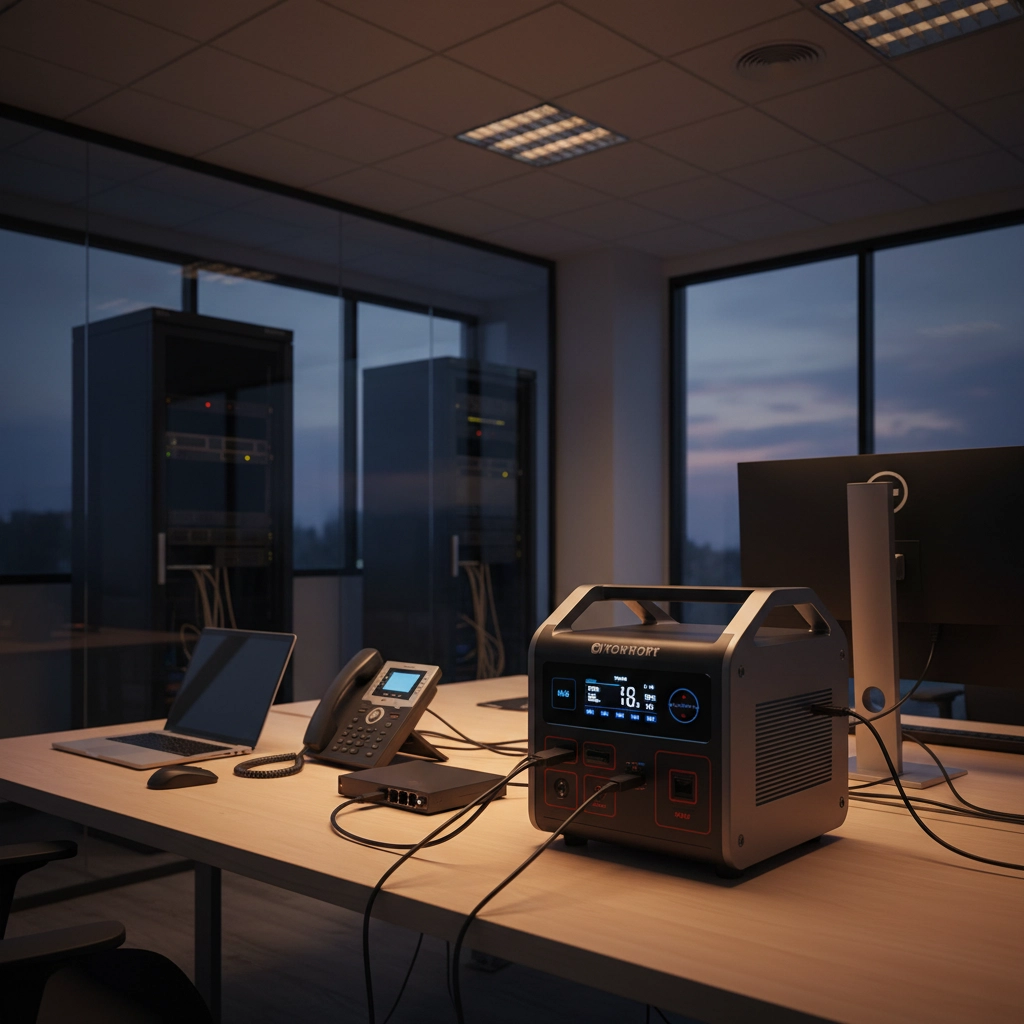
Portable power stations have revolutionized backup power for small businesses, offering capabilities that seemed impossible just five years ago. These battery-powered units provide clean, quiet power that's transformed how businesses think about continuity planning.
Technical Advantages: Modern lithium-ion power stations deliver 500-3,000Wh of capacity in units weighing 15-60 pounds. The latest models feature pure sine wave output, making them suitable for sensitive electronics that generators might damage. Advanced models include:
- Multiple output types (AC, DC, USB-A, USB-C)
- App-based monitoring and control
- Solar charging capability
- Expandable battery systems
- Pass-through charging functionality
Operational Benefits: The silence factor cannot be overstated: operating at under 30dB, these units won't disrupt customer interactions or employee productivity. They're completely safe for indoor use, eliminating carbon monoxide risks that make generators dangerous in enclosed spaces.
Real-World Performance: A 1,000Wh power station can typically run:
- A laptop for 10-15 hours
- LED lighting for 20-40 hours
- A small refrigerator for 10-20 hours
- Essential POS systems for 4-8 hours
Case Study Example: A boutique coffee shop in Vermont invested in a 2,000Wh power station after losing $3,000 in spoiled inventory during a winter storm. The unit now keeps their espresso machine, POS system, and refrigeration running during outages while maintaining the quiet atmosphere customers expect.
Traditional Generators: Proven Reliability
Gas generators remain the workhorses of backup power, offering advantages that battery technology hasn't matched. For businesses with high power demands or extended runtime needs, generators provide unmatched capability.
Power Output Advantages: Entry-level portable generators start at 2,000W, with common models providing 3,000-7,000W continuously. Standby generators can deliver 10,000-20,000W or more, handling entire facility loads including HVAC systems.
Runtime Capabilities: A generator's runtime is limited only by fuel availability. A typical 5,000W generator consumes about 0.75 gallons per hour at 50% load, providing 10-13 hours of operation from a standard tank. With fuel reserves, operation can continue indefinitely.
Cost Effectiveness: Initial purchase costs are significantly lower than equivalent power stations. A 3,000W generator costs $600-1,200, while a power station with similar output capability runs $2,000-4,000.
Limitations to Consider: Noise levels range from 60-90dB: comparable to a lawnmower or motorcycle. Most municipalities restrict generator operation to specific hours, and many commercial leases prohibit their use. They require regular maintenance including oil changes, filter replacements, and seasonal preparation.
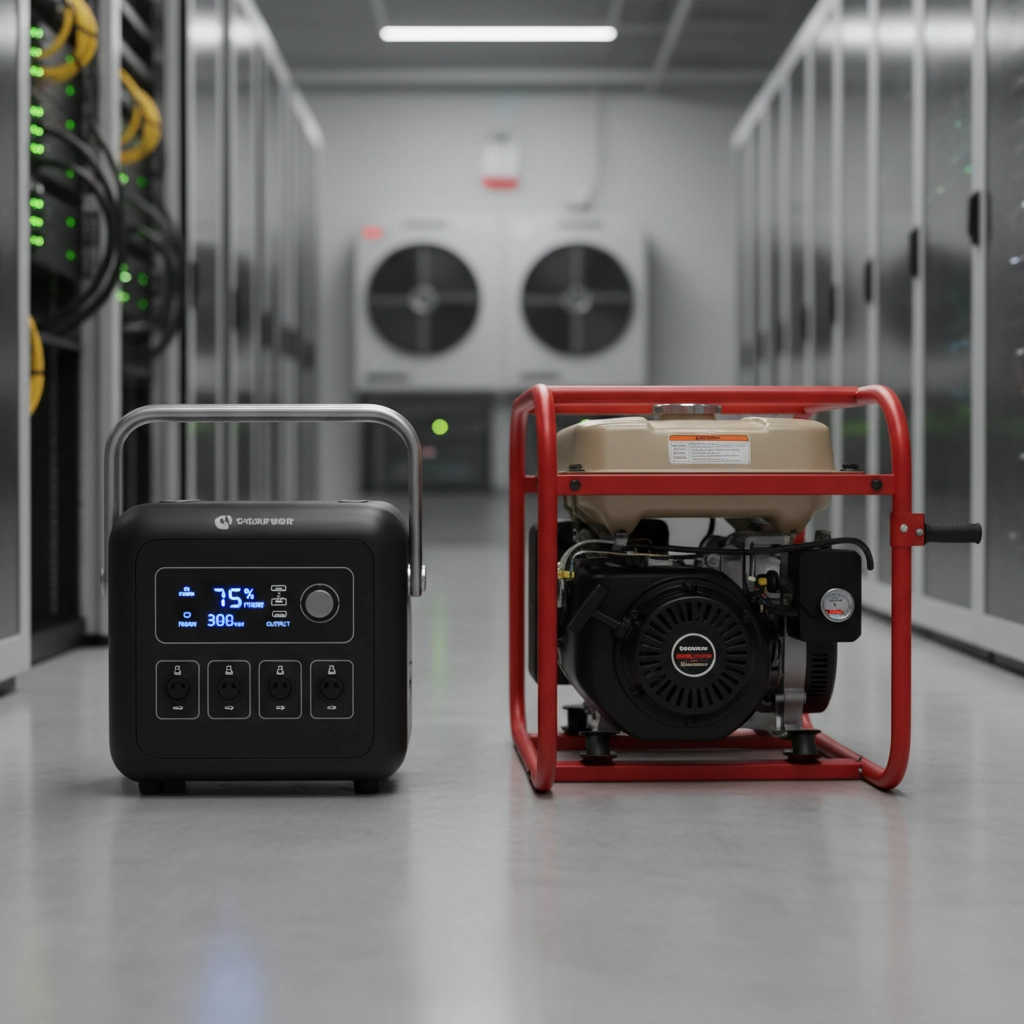
Side-by-Side Comparison
| Factor | Portable Power Station | Gas Generator |
|---|---|---|
| Noise Level | <30dB (library quiet) | 60-90dB (lawn mower loud) |
| Indoor Use | Completely safe | Dangerous (CO risk) |
| Startup Time | Instant | 10-30 seconds |
| Maintenance | Minimal (annual check) | Regular (monthly/seasonal) |
| Fuel/Energy Cost | $0.10-0.30/kWh | $3-5/gallon + maintenance |
| Initial Investment | $500-4,000 | $400-2,000 |
| Runtime | 2-20 hours (battery dependent) | Unlimited (with fuel) |
| Weight | 15-60 lbs | 50-200+ lbs |
| Emissions | Zero | Significant |
Real-World Applications and Case Studies
Scenario 1: Urban Retail Store A downtown boutique needed backup power that wouldn't violate noise ordinances or disturb neighboring businesses. A 1,500Wh power station keeps their POS system, lighting, and security cameras operational for 6-8 hours: covering 90% of typical outages while remaining completely neighbor-friendly.
Scenario 2: Workshop/Light Manufacturing A custom furniture maker requires power for both office systems and workshop tools. They use a hybrid approach: a power station handles computers and LED lighting, while a 5,000W generator powers dust collection systems and larger tools when needed outdoors.
Scenario 3: Home Office/Consulting A business consultant working from home invested in a 1,000Wh power station with solar charging capability. During Hurricane Ida, when grid power was out for 72 hours, solar panels kept the unit charged, maintaining internet connectivity and laptop power for client calls throughout the outage.

Procurement Considerations
Total Cost of Ownership Analysis: While generators have lower upfront costs, operational expenses add up quickly. A generator used 20 hours annually costs approximately:
- Fuel: $60-100
- Oil changes: $30-50
- Maintenance parts: $40-80
- Annual total: $130-230
A power station's annual operating cost is primarily electricity for charging: typically $15-40 annually.
Regulatory and Insurance Factors: Many business insurance policies offer discounts for silent backup power systems that don't pose fire or carbon monoxide risks. Check with your insurer about potential savings that could offset higher upfront costs.
Scalability Planning: Power stations offer easier expansion through modular battery systems. Many manufacturers provide add-on batteries that integrate seamlessly with existing units. Generator scaling typically requires purchasing an entirely new unit.
Vendor Selection Criteria:
- Warranty length and coverage scope
- Local service availability
- Battery replacement costs and availability
- Charging options and compatibility
- Load capacity matching your needs
Making the Right Choice for Your Business
For most small businesses in 2025, portable power stations represent the optimal balance of capability, convenience, and cost-effectiveness. They excel in environments where:
- Customer or employee comfort matters
- Indoor operation is required
- Noise restrictions exist
- Maintenance resources are limited
- Environmental consciousness is valued
Generators remain essential for businesses requiring:
- High continuous power output (>3,000W)
- Extended runtime beyond 12-24 hours
- Cost minimization as the primary concern
- Outdoor operation capability
The hybrid approach: using both technologies strategically: offers maximum flexibility for businesses with diverse power needs or those wanting comprehensive outage protection.
Your Next Steps
Power outages don't wait for convenient timing. Assess your power requirements today using the guidelines above, then match your needs to the right technology. Consider starting with a properly sized power station for immediate protection while evaluating whether additional generator backup makes sense for your specific situation.
Ready to protect your business from power disruptions? Contact our team for a free power assessment and customized backup solution recommendations. Our power protection specialists can help you calculate exact requirements and identify the most cost-effective protection strategy for your business.
Meta Description: Compare portable power stations vs generators for small business backup power in 2025. Expert analysis of costs, capabilities, and real-world applications to help you choose the right solution.
Related Posts:
- "Essential UPS Systems for Small Business IT Infrastructure"
- "Solar Backup Power: Future-Proofing Your Business Energy Strategy"
- "Power Quality Issues That Could Be Destroying Your Equipment"
Questions for Discussion: What's been your experience with power outages in your business? Have you considered how much downtime actually costs your operation? Share your backup power challenges in the comments below.