

Partial State of Charge: The Lithium Technique That Turns Backup Into a Revenue Asset
For decades, facility batteries had one job: remain ready for an outage. Most of the time, they sat idle, fully charged, waiting for a utility failure, generator start sequence, or controlled shutdown.
That model is changing. Lithium-ion battery energy storage systems can now support normal operations while preserving their emergency role. When properly engineered, a battery system can reduce demand charges, respond to utility events, shift energy consumption, and participate in grid-service programs: without sacrificing the reserve required to protect critical loads.
The control strategy behind this model is partial state of charge, or PSOC. It is not a license to cycle batteries indefinitely without wear. Cycling always creates some degradation. Instead, PSOC uses a controlled middle range of the battery’s capacity to reduce unnecessary stress while creating additional economic value.
For facility managers, data center operators, and CFOs, the opportunity is clear: treat backup storage as a resilience asset first and a flexible energy asset second.
What Partial State of Charge Means
State of charge, or SOC, describes how much usable energy remains in a battery. A battery at 100% SOC is fully charged; one at 20% SOC has approximately one-fifth of its available energy remaining, subject to battery-management-system limits.
PSOC operation keeps the battery inside a defined SOC band rather than repeatedly charging to 100% and discharging toward 0%. Typical operating strategies may use:
- A broad operating window of approximately 20% to 80% SOC
- A more conservative operating window of 30% to 70% SOC
- A narrow regulation band such as 35% to 65% SOC
- A standby target near 50% to 60% SOC when maximum energy availability is not immediately required
The correct window depends on the battery chemistry, manufacturer warranty, required runtime, inverter rating, utility program, and facility risk tolerance.
The goal is to keep enough energy available for backup while preventing the battery from spending excessive time at the conditions that accelerate aging: very high SOC, very low SOC, elevated temperature, high current, and deep discharge.
Why Lithium Batteries Are a Better Fit for Dual-Use Operation
Traditional valve-regulated lead-acid batteries remain common in UPS installations, but they are generally designed for standby service. Frequent cycling can shorten their useful life and create maintenance challenges.
Lithium-ion systems are better suited to repeated PSOC operation because they typically offer:
- Higher usable energy density
- Faster charge and discharge response
- Lower maintenance requirements
- Better cycle-life performance
- More precise battery monitoring
- Smaller footprints for equivalent runtime
- Advanced battery-management-system visibility
Lithium iron phosphate, or LFP, is increasingly common in stationary storage because of its cycle life and thermal characteristics. Nickel-rich lithium chemistries can offer high energy density but may require more careful thermal and operating controls. Chemistry alone does not determine project suitability. Cell design, module construction, thermal management, BMS controls, warranty terms, and installation standards all matter.
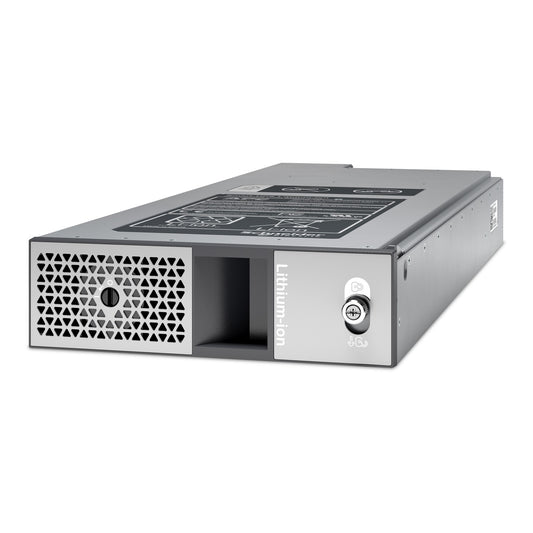
Ace Real Time Solutions offers access to battery and UPS solutions from leading manufacturers, including lithium modules such as the APC Smart-UPS Modular Ultra lithium-ion battery module. The appropriate product should be selected based on the full operating profile: not simply the nameplate capacity.
The Technical Reality: PSOC Reduces Stress, but Does Not Eliminate Degradation
The business case for PSOC must begin with a realistic battery-aging model.
Lithium-ion degradation generally appears in two forms:
- Calendar aging: capacity loss and resistance growth that occur over time, even when the battery is not cycling.
- Cycle aging: degradation caused by charge and discharge activity, including the number of cycles, depth of discharge, current rate, temperature, and SOC range.
Research published in the Journal of The Electrochemical Society found that SOC swing range was a major factor in degradation during grid-service duty cycles. The study compared frequency regulation and peak-shaving profiles and found that wider SOC operation and more demanding service profiles produced greater capacity loss and impedance growth. It also identified differences between LFP and nickel-rich electrode chemistries.
Read the study, “Lithium-Ion Battery Degradation in Grid Applications”, before approving any dual-use storage project.
For many commercial and industrial applications, a practical starting point is:
- Routine operation between 20% and 80% SOC
- A preferred long-term band of 30% to 70% SOC where the economics permit
- Average cell temperatures near 25°C
- Avoiding sustained operation above approximately 35°C
- Moderate operating rates around 0.5C to 1C, unless the system is specifically designed for higher power
- Maintaining a protected emergency reserve, often determined by required runtime rather than a generic SOC percentage
A 1 MW / 2 MWh battery is a nominal 0.5C system if discharged at 1 MW for two hours. At 2 MW, it becomes a 1C system with approximately one hour of nominal duration. Higher C-rates can deliver more power, but they may increase heat generation, resistance, and degradation.
The crucial point is that PSOC makes cycling more controlled: not free.
How Backup Storage Becomes a Revenue Asset
A dual-use battery can provide several value streams, subject to local tariffs, utility rules, market access, and equipment approvals.
1. Peak shaving
Commercial utilities often calculate demand charges using the facility’s highest demand during a defined interval, commonly 15 or 30 minutes. A BESS can discharge when the facility approaches its demand threshold, reducing the amount of power pulled from the grid.
For example, an illustrative 500 kW reduction at a demand charge of $18 per kW-month would produce:
500 kW × $18 × 12 months = $108,000 per year
Actual results depend on the tariff, load profile, battery duration, dispatch accuracy, and whether the facility experiences one or multiple monthly peaks.
2. Demand response
Demand response programs compensate customers for reducing grid consumption during defined events. A battery can discharge behind the meter so that the facility reduces its net grid demand without interrupting production, cooling, healthcare operations, or IT workloads.
The Federal Energy Regulatory Commission’s demand-response framework distinguishes demand response from electric storage resources, but batteries can still deliver demand-response effects by reducing net consumption or participating through an aggregator.
3. Energy arbitrage and load shifting
Where time-of-use rates apply, the battery can charge during lower-cost periods and discharge during higher-cost periods. This is usually more attractive when combined with demand-charge management, onsite solar, or a utility incentive.
Arbitrage should not override the facility’s resilience requirement. The system must retain enough energy to support critical loads during an outage or grid event.
4. Grid services
In some markets, batteries can provide fast response for frequency regulation or other ancillary services. These services may involve shallow, rapid charge and discharge movements around a mid-range SOC.
This is where PSOC is especially useful. The battery can move up and down within a defined band while preserving reserve in both directions. However, grid participation requires appropriate controls, communications, metering, market enrollment, and contractual approval.
The PSOC Business Case Roadmap
1. Define the non-negotiable backup requirement
Start with the emergency mission, not the revenue opportunity.
Document the protected load in kW, required runtime in minutes or hours, allowable transfer time, generator-start assumptions, and the redundancy model. A Tier III facility may require maintainable redundancy, while a Tier IV design requires fault tolerance and independent distribution paths. An N+1 or 2N UPS architecture may also impose limits on how storage can be dispatched.
Your revenue strategy must never reduce the reserve needed to meet the facility’s continuity standard.
2. Build an aging-aware dispatch profile
Model the expected number of cycles, equivalent full cycles, depth of discharge, C-rate, SOC range, and temperature. Peak shaving, frequency regulation, and demand response do not impose the same stress.
Use manufacturer warranty curves and throughput limits. A warranty based on eight years of standby operation may not cover daily dispatch for peak shaving. Confirm whether the warranty permits revenue-generating grid services and what operating limits apply.
3. Select the right chemistry and architecture
Compare LFP and other lithium-ion chemistries based on cycle life, energy density, thermal management, power capability, serviceability, and fire-protection requirements.
Decide whether the system should be:
- DC-coupled to a compatible UPS
- AC-coupled behind the facility switchgear
- Integrated with a bidirectional power-conversion system
- Managed by a dedicated energy-management system
- Isolated from the mission-critical UPS battery reserve
For many data centers, a separate BESS may be preferable to using the primary UPS battery for market dispatch. This preserves a clean operational boundary between commercial cycling and emergency backup.
4. Quantify the complete financial model
Calculate annual value from:
- Demand-charge reduction
- Demand-response payments
- Energy arbitrage
- Frequency or ancillary services
- Renewable-energy self-consumption
- Avoided generator runtime, where applicable
Then subtract:
- Battery degradation
- Replacement or augmentation
- HVAC and thermal-management energy
- Software and market-participation fees
- Maintenance and testing
- Interconnection and permitting costs
- Additional controls, metering, and cybersecurity requirements
A project that looks profitable before degradation may become marginal after five to ten years. CFOs should require a sensitivity analysis for electricity prices, event frequency, battery replacement timing, and declining usable capacity.
5. Monitor the system in real time
A PSOC strategy depends on accurate data. The BMS should track cell voltage, temperature, current, SOC, state of health, alarms, and imbalance. The energy-management system should coordinate dispatch with facility load, utility signals, generator status, and the protected reserve.
Remote visibility is essential. The Ace Real Time Solutions services team can help assess power delivery, UPS systems, battery infrastructure, and ongoing support requirements.
What Facility Leaders Should Do Next
The best first step is a power audit. Review the last 12 months of interval load data, utility tariffs, outage history, generator performance, UPS loading, battery age, and critical-load requirements.
Then compare three scenarios:
- Standby-only backup
- PSOC operation for peak shaving and demand response
- A dedicated BESS operating alongside the UPS system
The result should be a technical and financial design that protects uptime before pursuing revenue.

Modern Real-Time Solutions make power infrastructure more measurable, controllable, and valuable. But the operating model must be engineered around resilience. A battery that earns revenue but cannot support the next outage is not a successful power-protection asset.
To evaluate a lithium-ion UPS or BESS project, visit Ace Real Time Solutions, review the battery solutions collection, or submit an enterprise request for quote. Contact the team to request a technical specification sheet, power audit, or customized solution design.
Frequently Asked Questions
What is partial state of charge operation?
Partial state of charge operation keeps a lithium-ion battery within a defined SOC range: such as 30% to 70%: instead of repeatedly charging to 100% and discharging toward empty. The strategy can reduce time spent at stressful operating conditions while preserving energy for backup, peak shaving, or demand response.
How does PSOC enable a UPS or BESS to generate revenue?
PSOC allows a properly designed battery system to cycle within a controlled operating band while retaining an emergency reserve. The system may reduce facility demand charges, respond to utility events, shift energy use, or provide eligible grid services. Revenue depends on tariffs, market rules, dispatch capability, warranties, and degradation costs.
How does lithium battery chemistry affect PSOC performance?
Lithium chemistry affects cycle life, thermal behavior, energy density, power capability, and operating limits. LFP is widely used in stationary storage because of its cycle-life and thermal characteristics, while other lithium chemistries may provide higher energy density. The final selection must also consider the BMS, thermal management, inverter, warranty, installation environment, and required backup profile.