

OCP's New Energy Storage Safety Guidance: What Lifecycle Testing Means for Your UPS Procurement
The State of the Union: UPS Batteries Are Now a Data Center Safety Issue
Data center energy storage is changing faster than traditional procurement processes. AI and high-performance computing are driving higher rack densities, more variable loads, and larger UPS deployments. A battery system that once supported a relatively predictable IT load may now operate within a facility containing megawatts of critical equipment, tightly controlled thermal management, and limited tolerance for downtime or unsafe conditions.
The Open Compute Project’s January 2026 guidance, Requirements for Energy Storage Systems Used in Data Centers, reflects this shift. The document treats energy storage as a lifecycle responsibility: not simply a product purchase. Design, testing, installation, commissioning, maintenance, replacement, transport, redeployment, emergency response, and end-of-life handling all matter. For procurement teams, that means a low bid with incomplete safety documentation can create substantial compliance, insurance, and operational risk later.
The guidance references NFPA 855 and ANSI/CAN/UL 9540A as important tools for evaluating thermal runaway and fire propagation. It also addresses the practical realities of data center deployments, including MW-scale UPS systems, outdoor battery energy storage systems, and emerging high-voltage DC architectures.
Why Now: The Status Quo Is Failing
Many UPS specifications still focus heavily on purchase price, VA capacity, runtime, efficiency, and warranty duration. Those metrics remain essential, but they do not fully describe the risk profile of a modern lithium-ion or advanced battery installation.
Three problems are becoming more visible.
1. Redundancy does not eliminate battery risk
A 2N UPS design can protect against the failure of one power path, but redundancy does not automatically prevent a battery incident from affecting adjacent systems, electrical rooms, or emergency egress routes. A facility may have redundant UPS modules while still depending on a single battery room, shared ventilation system, or common monitoring platform.
2. Thermal management is part of safety
Battery performance and safety depend on operating temperature, charging conditions, enclosure design, ventilation, and detection. A vendor that provides a test report for one cabinet configuration may not have validated the same behavior when cabinets are installed in a dense room with different spacing, airflow, suppression, or gas-management systems.
3. Latency in documentation becomes deployment latency
If a vendor cannot provide test summaries, configuration records, safety data sheets, installation requirements, and emergency procedures during procurement, those documents may become a problem during permitting or AHJ review. The result is avoidable schedule delay at precisely the point when a data center needs predictable delivery.
The answer is not to reject every lithium-ion UPS. The answer is to evaluate the complete system and its evidence.
What UL 9540 and UL 9540A Actually Prove
Procurement teams should distinguish between three related but different concepts.
UL 9540: system-level safety
UL 9540 addresses the safety of an energy storage system and its equipment. It is concerned with the assembled system, including electrical protection, controls, wiring, grounding, insulation, mechanical construction, and abnormal operating conditions.
For a UPS project, the relevant question is whether the listed configuration represents the complete battery energy storage subsystem: not merely the individual cells or battery modules.
UL 9540A: thermal runaway and fire propagation
UL 9540A is a test method, not a general product-performance certification and not a cycle-life test. It evaluates what happens when battery cells are intentionally driven into thermal runaway.
Testing can examine:
- Cell behavior, including vent gases and flammability
- Cell-to-cell propagation within a module
- Module-to-module behavior within a unit
- Heat release, gas release, ignition, and deflagration potential
- Fire spread and protection performance at the installation level
The UL 9540A test method uses a staged approach. The fifth edition includes cell-, module-, unit-, and installation-level testing. The sixth edition, published on March 13, 2026, revises installation-level testing and formalizes a large-scale fire test approach aligned with NFPA 855 guidance.
For non-residential systems, the sixth edition changes when unit-level testing is required. It also addresses large-scale deflagration testing and the performance of active thermal runaway propagation prevention systems. Vendors should identify which edition they used, which test levels were completed, and whether the tested configuration matches the proposed UPS installation.
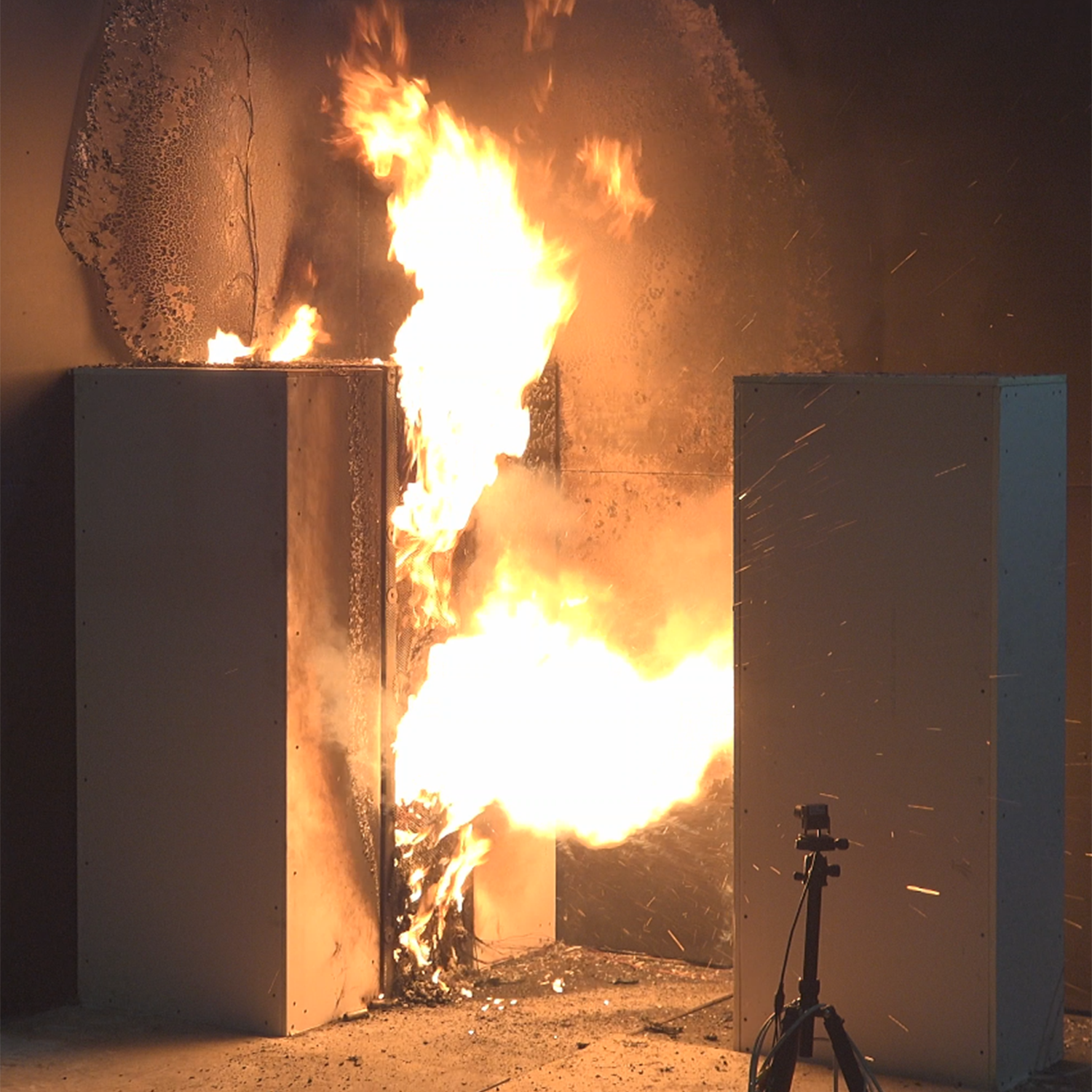
UL 9540A results help engineers and authorities evaluate fire spread, heat release, gas hazards, separation distances, and protection requirements. Image source: UL Solutions.
Lifecycle testing is broader than UL 9540A
This distinction is critical: UL 9540A does not prove that a battery will deliver its rated runtime after ten years, nor does it measure capacity fade, charging efficiency, or cycle life.
A complete lifecycle qualification program should combine:
- UL 9540 system-level safety evidence
- UL 9540A thermal runaway testing
- UPS electrical performance testing, including overload and transfer behavior
- Battery capacity and runtime testing
- Thermal performance and environmental testing
- Battery management system validation
- Monitoring, alarm, and communications testing
- Replacement, repair, transport, and end-of-life procedures
UL 9540A becomes part of lifecycle governance because its assumptions must remain valid as the asset changes.
What Lifecycle Evidence Should Follow the UPS?
A credible vendor should be able to explain how safety documentation applies at each stage.
Initial deployment: The tested battery chemistry, module design, cabinet, enclosure, spacing, ventilation, and protection systems should correspond to the proposed installation.
Commissioning: The integrator should document battery serial numbers, firmware versions, BMS settings, torque checks, thermal conditions, alarm points, and acceptance-test results.
Operation and maintenance: The owner should receive inspection intervals, alarm response procedures, thermal monitoring requirements, and clear instructions for isolating a suspect cabinet without compromising critical loads.
Replacement and upgrade: A replacement module should not be treated as automatically equivalent. Changes in chemistry, cell format, module capacity, enclosure design, firmware, or packing density may require a new engineering review or updated test evidence.
Redeployment: Moving a battery cabinet from one data hall to another can change spacing, ventilation, fire compartments, and egress conditions. The original test assumptions may no longer apply.
Return and end of life: Damaged or retired lithium batteries require controlled packaging, labeling, transportation, and recycling procedures. Ask vendors how they address UN Manual of Tests and Criteria, Part III, Subsection 38.3, where applicable.
The UPS Safety Procurement Roadmap
Facility managers and procurement teams can take these five steps today.
1. Define the installed system, not just the UPS model
Your RFP should identify the expected topology, capacity, runtime, cabinet count, room layout, and future expansion. Include whether the system will be deployed in a dedicated battery room, electrical room, container, or rack-level architecture.
State the required electrical design clearly. For example, specify whether the project requires a 1 MW UPS block, N+1 capacity, 2N distribution, 10 or 15 minutes of runtime at the design load, and a target efficiency such as 96% or higher in the intended operating mode. Safety evidence must correspond to the same configuration.
2. Require a standards matrix
Ask each bidder to provide a matrix showing:
- UL 9540 listing status and scope
- UL 9540A edition used
- Test levels completed
- NFPA 855 alignment
- Applicable IFC requirements
- UPS certification, including UL 1778 where applicable
- Battery transportation and end-of-life requirements
- Exceptions, limitations, and pending certifications
Do not accept “compliant with all applicable standards” without supporting documentation.
3. Tie test evidence to the proposed installation
Require vendors to explain the differences between the tested system and the proposed system. At minimum, review:
- Battery chemistry and cell format
- Module and cabinet count
- Energy per unit and total energy per fire area
- Cabinet spacing and room geometry
- Ventilation and gas-management assumptions
- Detection and suppression systems
- Active thermal runaway prevention features
- Firmware and BMS version
- Required separation from egress paths and adjacent equipment
For context, NFPA 855 and local codes may use energy thresholds and separation distances: such as 50 kWh group limits or 3-foot spacing: in determining when additional testing or protection measures apply. These values must be verified against the adopted code, system configuration, and AHJ requirements rather than copied into an RFP without engineering review.
4. Score documentation as a technical deliverable
Price should not outrank missing safety evidence. An illustrative scorecard might assign:
- 25% safety certification and test evidence
- 20% configuration control and lifecycle support
- 20% electrical performance and reliability
- 15% installation, commissioning, and service capability
- 10% monitoring, alarms, and remote support
- 10% commercial value and total cost of ownership
The percentages can change, but the principle should not: the least expensive system is not the lowest-cost system if incomplete documentation delays permitting or forces redesign.
5. Put change control in the contract
Require written notification before the vendor changes cell suppliers, chemistry, module design, cabinet layout, BMS firmware, thermal controls, or manufacturing location. The contract should state when updated safety evidence, retesting, or AHJ review is required.
What Good Vendor Documentation Looks Like
A strong response package is organized, specific, and traceable. It should include:
- Current certificates and listing information
- UL 9540A test report or a detailed third-party summary
- Test edition and date
- Cell, module, unit, and installation test results
- Heat-release and gas-generation data where available
- Deflagration or explosion-control information
- Installation drawings and spacing requirements
- Emergency response and isolation procedures
- Battery monitoring and alarm points
- Maintenance and replacement procedures
- Transportation and end-of-life instructions
- A documented transition plan for future standards or certification changes
A red flag is a vendor that supplies only a product brochure, a generic cell-level report, or an assertion that “the battery chemistry is inherently safe.” Chemistry matters, but the installed system determines how heat, flame, and gases move through a real facility.
Ace Real Time Solutions approaches UPS procurement as a complete power-protection program. Our services include system design, professional installation, battery support, monitoring, and lifecycle planning. Review our enterprise request for quote, explore battery solutions, or learn how our hardware, software, and service approach supports critical infrastructure.

Conclusion: Buy Evidence, Not Just Equipment
The OCP guidance makes an important procurement principle explicit: energy storage safety continues after delivery.
UL 9540 and UL 9540A are valuable, but neither replaces a complete lifecycle program. Procurement teams should demand evidence that connects the tested battery system to the actual data center installation, maintenance plan, monitoring strategy, replacement process, and end-of-life path.
That is the modern Real-Time Solutions standard: measurable protection, documented assumptions, controlled change, and support that continues after commissioning.
To request a power audit, solution design, or technical specification review, visit acerts.com or contact Ace Real Time Solutions through our services page.
Frequently Asked Questions
What is UL 9540A?
UL 9540A is a standardized test method for evaluating thermal runaway fire propagation in battery energy storage systems. It examines behavior at cell, module, unit, and installation levels and generates information about heat release, gas generation, flame spread, and deflagration risk.
How does UL 9540A affect UPS procurement?
UL 9540A gives procurement teams evidence for evaluating whether a proposed UPS battery configuration can limit thermal runaway propagation and meet applicable fire-protection requirements. RFPs should identify the test edition, test levels, configuration tested, and differences between the test setup and the proposed installation.
What lifecycle documents should a UPS vendor provide?
A vendor should provide certification records, UL 9540A test information, installation requirements, emergency procedures, monitoring and maintenance guidance, replacement controls, transportation documentation, and end-of-life instructions. The vendor should also explain when design or firmware changes require updated testing or AHJ review.