
Modular vs. Monolithic UPS: Which One Scales Better with a Growing Business?
If your business is growing: and let's face it, that's the goal: your power protection strategy needs to grow with it. But here's the problem: most companies lock themselves into a UPS architecture that either forces them to overspend upfront or scramble to retrofit when they outgrow their capacity.
The choice between modular and monolithic UPS systems isn't just about watts and volts. It's about future-proofing your infrastructure without breaking the bank or causing downtime every time you need to scale up. According to Gartner, downtime costs businesses an average of $7,900 per minute. That means getting your power protection strategy wrong from the start can cost you exponentially as you grow.
So which architecture actually scales better? Let's break down both options and see how they stack up when your business needs to expand.
Understanding the Two Architectures
Before we dive into scalability, let's make sure we're on the same page about what we're comparing.
Monolithic UPS systems are the traditional approach: a single, self-contained unit designed to deliver a fixed capacity. Think of it like buying a truck with a set payload capacity. It does the job, and it does it reliably, but if you need to haul more, you're buying another truck.
Modular UPS systems take a different approach. They use a frame-based design where you can add or remove individual power modules as needed. It's more like having a cargo system where you can add trailer sections when your load increases.
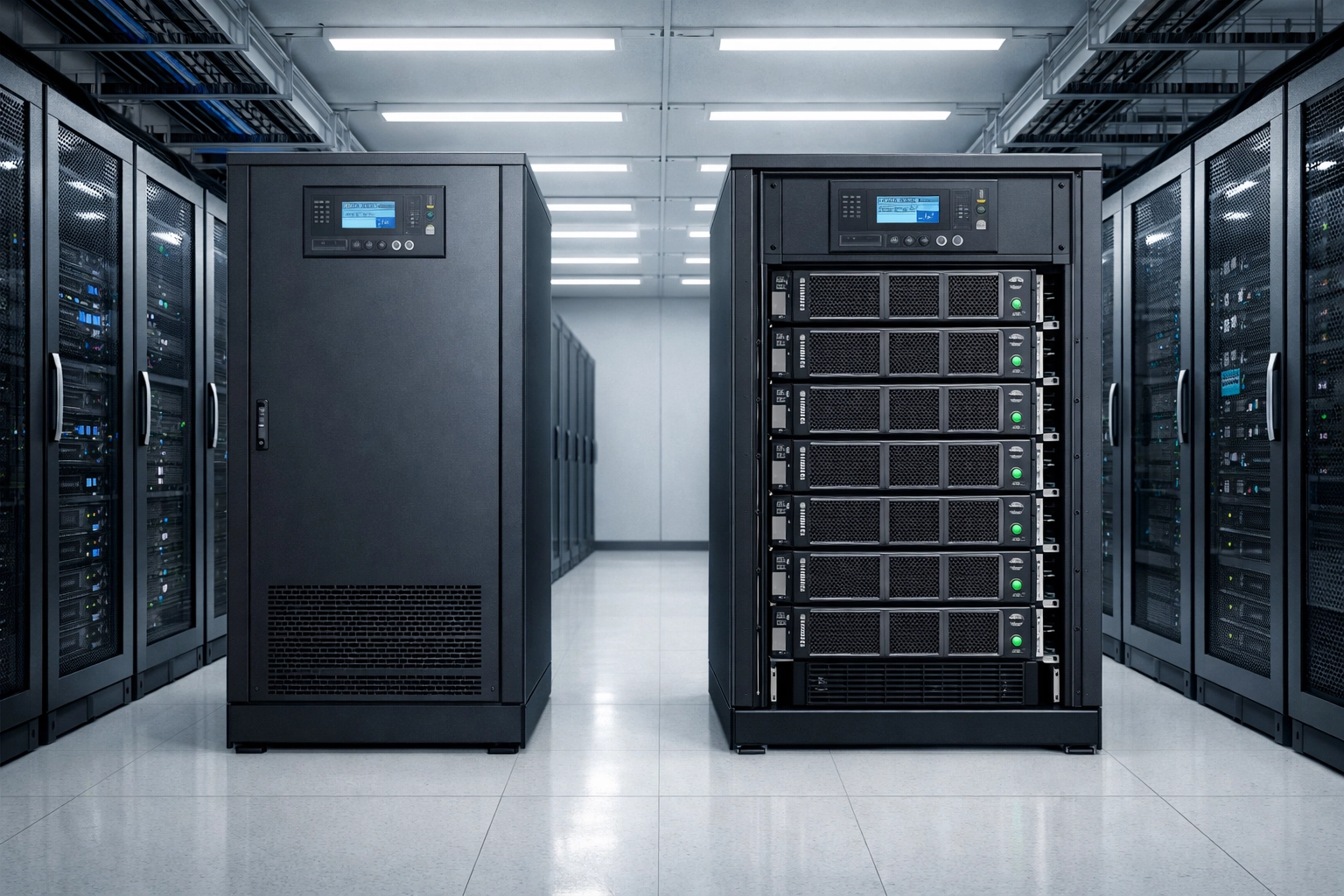
The key difference? Flexibility. Monolithic systems deliver fixed capacity out of the box. Modular systems let you start small and build capacity incrementally without replacing the whole system.
How Each System Scales: The Real-World Difference
Here's where the rubber meets the road. Let's say your data center currently needs 100 kW of protected power, but you're projecting 250 kW within three years as you onboard new clients and expand operations.
Scaling a Monolithic UPS
With a monolithic system, you have two choices:
- Buy the 250 kW system now and eat the cost of unused capacity for three years
- Buy a 100 kW system now and add parallel units later when you need more capacity
Option one means overprovisioning: you're paying for (and cooling, and maintaining) capacity you won't use for years. Option two means scheduling downtime for installation, coordinating parallel operation, and potentially dealing with different firmware versions if your expansion happens a few years down the road.
Neither option is ideal. And both involve significant capital expenditure upfront or major installation projects later.
Scaling a Modular UPS
Modular systems solve this problem with vertical and horizontal scaling:
- Vertical scaling: Add power modules directly into your existing frame. Need to go from 50 kW to 150 kW? Just plug in additional modules. No downtime, no major installation project.
- Horizontal scaling: Once your frame is fully populated, add another frame to the system. Modern modular architectures can scale from 50 kW all the way to 1.5 MW with built-in redundancy.
The modules are hot-swappable, meaning you can add capacity or perform maintenance without interrupting power to your critical loads. For a growing business, that's huge: you're never choosing between expansion and uptime.

The Cost Reality: Upfront vs. Long-Term
Here's where things get interesting. If you're comparing sticker prices, monolithic systems typically win on initial purchase cost. But that's not the whole story.
| Factor | Monolithic UPS | Modular UPS |
|---|---|---|
| Initial Cost | Lower upfront | Higher upfront |
| Overprovisioning | Required for growth | Pay as you grow |
| Installation Cost | Higher (heavier, more complex) | Lower (lighter modules) |
| Efficiency at Partial Load | Decreases significantly | Optimized automatically |
| Maintenance Downtime | Scheduled outages often required | Hot-swap modules, no downtime |
| Total Cost of Ownership (5-10 years) | Higher | Lower |
The real kicker is efficiency. When you overprovision a monolithic system, it runs at partial load: and UPS systems are most efficient when operating closer to their rated capacity. A 250 kW monolithic UPS running at 40% load (100 kW) is burning energy and generating heat unnecessarily.
Modular systems automatically adjust. As you add modules, the system reconfigures to maintain optimal efficiency. That efficiency difference adds up to thousands of dollars annually in energy costs for mid-sized installations.
Real-World Scenarios: When Each Makes Sense
Let's talk about actual use cases, because there's no one-size-fits-all answer here.
When Modular Makes Sense
Growing tech companies: If you're adding servers, expanding services, or scaling your SaaS platform, modular is the clear winner. You match capacity to actual demand and avoid the capital trap of overprovisioning.
Multi-tenant data centers: When your load is unpredictable because you're onboarding new customers at varying rates, modular systems let you scale in step with signed contracts rather than speculative projections.
Edge computing deployments: Starting small at edge locations with plans to expand? Modular systems give you a growth path without replacing equipment.
A hypothetical example: We worked with a fintech startup that needed 75 kW of protected power initially but projected 200 kW within 18 months based on customer growth. They went modular, starting with three 25 kW modules. When they hit their growth targets ahead of schedule, they simply added modules over a weekend: no downtime, no construction project, no emergency procurement scramble.
When Monolithic Still Works
Fixed, predictable loads: If you're protecting a manufacturing line or building automation system with a stable, unchanging load, a right-sized monolithic system is perfectly adequate and costs less upfront.
Smaller installations with no growth plans: For small businesses with 10-20 kW loads and no expansion on the horizon, the simplicity of a monolithic UPS makes sense.
Budget-constrained projects: If capital is extremely tight and you genuinely won't need to scale for many years, a monolithic system gets the job done.
Making the Right Choice for Your Business
So how do you actually decide? Here's a practical framework:
Choose Modular If:
- Your business is in growth mode (expanding staff, clients, or services)
- Your load requirements are uncertain or likely to change
- Downtime during upgrades or maintenance would be costly
- You're building a multi-year infrastructure roadmap
- Energy efficiency and TCO matter more than initial price
Choose Monolithic If:
- Your load is stable and unlikely to change significantly
- You need the lowest possible upfront cost
- Your installation is small (<25 kW) with no expansion plans
- You're protecting static infrastructure (HVAC, security, etc.)
Questions to Ask Yourself:
- What's our projected load in 3 years? 5 years?
- How certain are those projections?
- What does downtime cost our business per hour?
- Do we have the capital to overprovision now, or would incremental investment work better?
- Who's managing maintenance, and what's their tolerance for scheduled outages?
The Bottom Line
For most growing businesses, modular UPS systems offer better scalability and lower total cost of ownership despite higher initial prices. The ability to add capacity incrementally, maintain optimal efficiency, and avoid downtime during expansion makes them the smarter long-term investment.
That said, there's still a place for monolithic systems in stable, predictable environments where upfront cost matters most and growth isn't on the horizon.
The key is being honest about your growth trajectory and business needs. Overprovisioning a monolithic system "just in case" often ends up costing more than starting with a scalable modular architecture from day one.
Ready to Right-Size Your Power Protection?
Whether you're planning for growth or just trying to protect what you've already built, getting your UPS architecture right matters. At Ace Real Time Solutions, we help businesses design power protection strategies that match their actual needs: not just sell boxes.
Contact our team to discuss your specific requirements, or explore our full range of UPS solutions to see what makes sense for your operation.
Growing shouldn't mean gambling on your power protection. Let's build something that scales with you.