

Medium-Voltage UPS: How GE Vernova's New System Is Moving Power Protection Out of the Data Hall
AI data centers are forcing electrical design teams to reconsider where power protection belongs. Traditional architectures place low-voltage UPS systems close to the IT load, typically downstream of transformers and switchgear. That approach remains effective for many facilities, but it becomes more difficult to scale as campuses move toward multi-megawatt blocks, 30–100 kW racks, and rapidly changing AI workloads.
GE Vernova’s medium-voltage UPS announcement, formally made in Paris on August 24, 2026 and covered by industry media on September 6, signals a shift toward protecting larger portions of the facility upstream. Its MV-UPS platform is designed for AI data centers, AI factories, and other high-power facilities that require stable power through grid disturbances, load swings, and transitions between grid-connected and islanded operation.
The important architectural question is not simply whether an MV UPS is “better” than a conventional UPS. The question is whether moving power conversion and energy storage to the medium-voltage layer can reduce downstream complexity while improving power quality, site efficiency, and grid interaction.
Why Medium Voltage Matters Now
The status quo is under pressure from two directions.
First, AI compute creates fast and substantial changes in electrical demand. Training and inference workloads can change facility load in seconds or less. Those swings can stress utility interconnections, onsite generators, transformers, and mechanical systems. A conventional UPS may protect the downstream IT load, but the rest of the power train can still experience the consequences of the change.
Second, electrical distribution consumes valuable space. A large facility may require multiple transformer sections, low-voltage switchboards, UPS modules, static transfer switches, battery systems, maintenance bypass equipment, and extensive busway. As the facility expands, the electrical room can become a major constraint on the site plan.
Medium-voltage protection moves the stabilization point closer to the incoming utility connection and the main facility distribution network. Rather than installing numerous low-voltage UPS blocks after step-down transformers, a centralized MV-UPS can support a much larger critical-load section.
That is the architectural shift: power protection moves out of the data hall and into the medium-voltage zone.
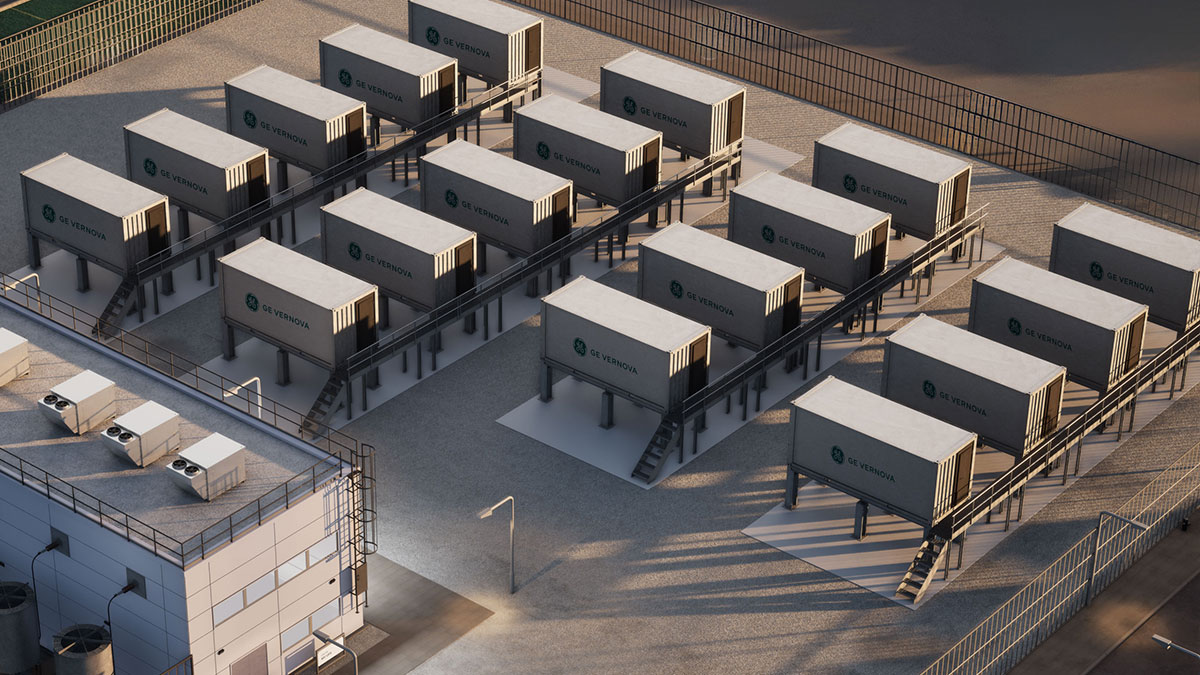
What an MV UPS Does Differently
A conventional low-voltage UPS generally receives utility power, converts and conditions it, stores energy in batteries, and supplies downstream loads at a low-voltage output such as 400/230 V or 480/277 V.
An MV UPS performs the same broad mission at a higher point in the electrical system. It combines power conversion, controls, and energy storage to stabilize the facility’s medium-voltage network. GE Vernova describes its platform as creating a medium-voltage, DC-coupled island that separates critical loads from grid transients, voltage dips, and frequency events.
The distinction between a series-connected UPS and a parallel-connected BESS is important. A shunt-connected battery energy storage system operates alongside the load. It can inject or absorb power, but it does not necessarily isolate the load from every upstream disturbance. A series-connected UPS architecture places the conversion system directly in the path between the source and the protected load.
That can provide three capabilities:
- Voltage and frequency conditioning for sensitive compute and control systems.
- Fast buffering of load changes so rapid demand swings are not passed directly to the utility or onsite generation.
- Grid-forming and islanding support when the site must operate through a disturbance or independently of the grid.
This does not eliminate the need for sound protection coordination, selective breaker settings, grounding design, or downstream distribution engineering. It changes where those functions are concentrated.
The Space and Current Advantage
Medium voltage can reduce conductor current dramatically for the same power level.
For example, a three-phase 10 MW load at 480 V and unity power factor requires approximately 12,000 amps before accounting for system losses and operating margin. At 13.8 kV, the same real power requires approximately 418 amps. Actual designs depend on power factor, voltage tolerance, harmonics, transformer configuration, fault duty, and operating margin, but the comparison illustrates why large facilities distribute power at medium voltage.
Lower current can support:
- Smaller conductors and busbars.
- Lower transformer and switchboard ratings downstream.
- Fewer parallel low-voltage UPS blocks.
- Reduced electrical-room footprint.
- More flexible site planning for high-density compute.
GE Vernova states that its MV-UPS architecture can reduce or eliminate the need for separate low-voltage UPS and secondary BESS systems in certain designs. That benefit must be evaluated at the system level. A smaller UPS room does not automatically mean a smaller project if the MV equipment requires additional clearances, arc-flash boundaries, ventilation, fire protection, battery separation, or specialized operator access.
The correct comparison is total installed and lifecycle cost: not the footprint of one cabinet.
Efficiency: Look Beyond the Nameplate
Efficiency is another potential benefit, but it requires disciplined analysis.
Every conversion stage adds losses. A conventional architecture may include medium-voltage-to-low-voltage transformation, UPS conversion, distribution losses, and additional conversion inside power supplies. An MV UPS may consolidate portions of that chain and reduce the number of downstream conversion steps.
Facility managers should request efficiency curves at 25%, 50%, 75%, and 100% load. A UPS that delivers 98% efficiency at full load may operate very differently at partial load. That matters because many data centers are commissioned in phases and may run well below their ultimate design capacity for years.
The evaluation should include:
- Normal operating efficiency.
- Double-conversion efficiency.
- Eco-mode or bypass behavior, where applicable.
- Battery charging losses.
- Transformer losses.
- Cooling energy for the electrical room.
- Efficiency under redundant operating conditions.
- Harmonic filtering and power-factor performance.
- Degradation over battery life.
An MV architecture should also be assessed against the project’s target PUE. The goal is not merely to select a high-efficiency UPS. It is to reduce total facility energy overhead while preserving the availability target.
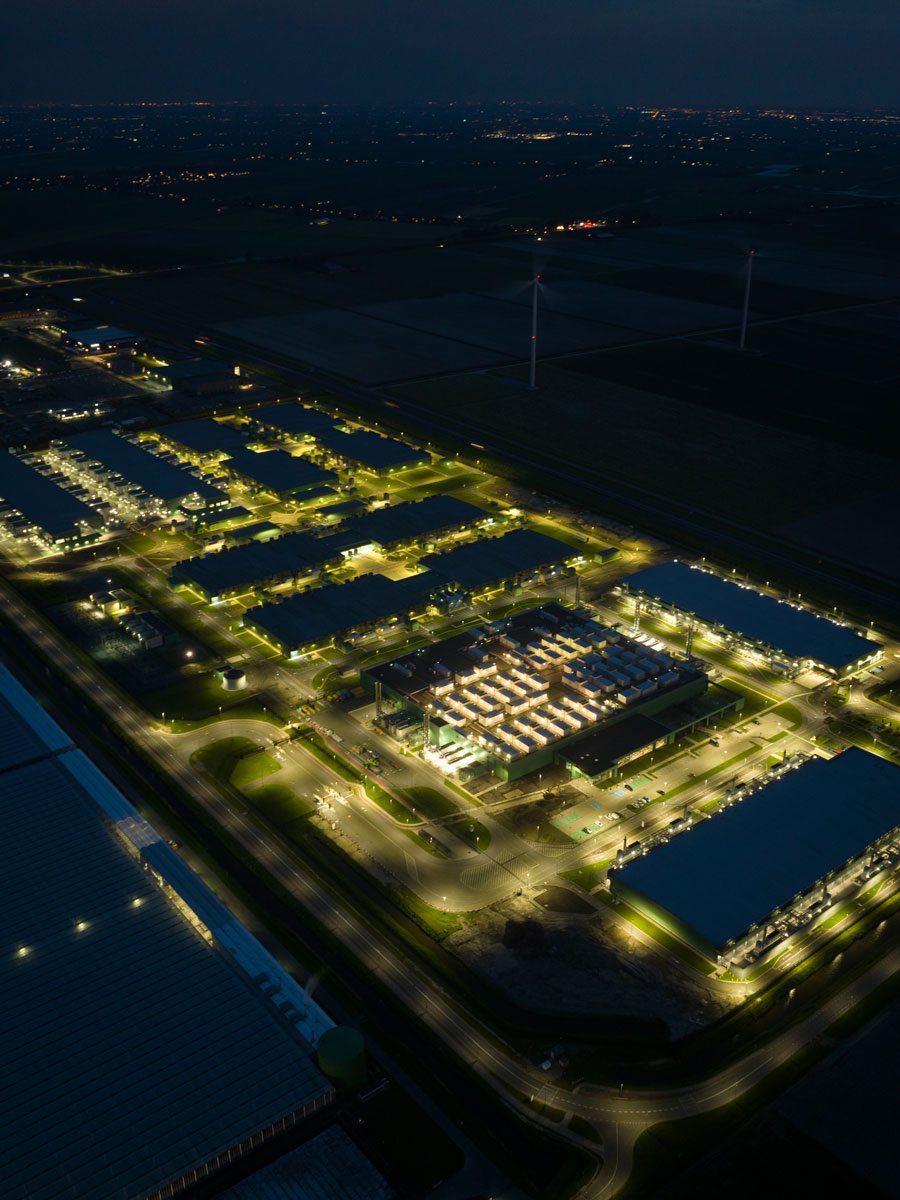
Where MV UPS Fits in Tier III and Tier IV Designs
Moving protection upstream does not replace the need for redundancy.
A Tier III facility requires concurrently maintainable infrastructure. A Tier IV facility requires fault-tolerant infrastructure with independent systems and compartments. An MV UPS must therefore be evaluated within the full power architecture, including incoming services, substations, switchgear, transformers, generators, energy storage, controls, and downstream distribution.
Possible configurations may include:
- N+1 MV UPS modules supporting a common critical bus.
- 2N independent MV power paths feeding separate data hall distribution systems.
- Dual utility services with independent MV conversion systems.
- Separate A and B power trains for dual-corded IT equipment.
- Centralized MV protection combined with localized UPS systems for control, network, or edge loads.
The right configuration depends on the facility’s critical-load profile. A high-density AI hall may justify centralized MV protection, while office spaces, security systems, fire alarms, network rooms, and building management systems may still require smaller local UPS units.
The system must also be coordinated with generator controls. If an AI workload can change from 20% to 80% of a large load block rapidly, the MV UPS should absorb the transient while generators respond at a controlled rate. This reduces mechanical and electrical stress and helps maintain stable frequency.
Who Should Consider Medium-Voltage UPS?
MV UPS is most relevant for organizations designing or expanding large, power-dense facilities. It deserves early consideration when a project has one or more of the following characteristics:
- A planned critical load measured in multiple megawatts.
- AI racks or accelerator clusters with rapidly changing demand.
- Limited land for electrical infrastructure.
- Long utility interconnection timelines.
- A requirement for bridging power before permanent grid service.
- Onsite generation or microgrid operation.
- Strict utility ramp-rate or power-quality requirements.
- A phased campus expected to grow substantially.
- A need to protect generator assets from rapid load swings.
- A target of Tier III or Tier IV availability.
It is less likely to be the best fit for a small enterprise server room, a modest colocation facility, or a site whose primary problem is short-duration protection for a limited number of racks. In those environments, a properly sized low-voltage UPS, battery system, rack PDU, and remote monitoring platform may be more practical.
The decision should be made during concept design, not after the low-voltage distribution system has already been finalized. GE Vernova specifically emphasizes early planning because an MV UPS replaces or reshapes major parts of the conventional electrical architecture.
The Medium-Voltage UPS Roadmap
Facility managers and design teams should take five steps before selecting an MV UPS:
-
Map the load profile, not just the connected load.
Document base load, peak load, rack density, expected MW growth, step changes, power factor, harmonic content, and the behavior of AI training and inference cycles. -
Compare complete electrical topologies.
Model a conventional low-voltage UPS design against MV UPS, BESS, generator, and hybrid alternatives. Include transformers, switchgear, busway, cooling, controls, maintenance access, and construction sequencing. -
Define the availability architecture early.
Establish whether the project requires N+1, 2N, distributed redundant, or another configuration. Verify how maintenance and single-fault scenarios affect the critical bus. -
Validate grid and generator interactions.
Analyze fault ride-through, reactive power, ramp-rate limits, islanding, black start, generator loading, transfer sequences, and protection coordination with the utility and authority having jurisdiction. -
Build a lifecycle monitoring and service plan.
Require real-time visibility into battery health, conversion efficiency, power quality, thermal conditions, alarms, and maintenance status. Remote monitoring and periodic power-quality audits are essential for a system that sits at the center of the facility’s electrical architecture.

Real-Time Solutions for the Power Layer
Medium-voltage UPS technology is not a universal replacement for conventional UPS systems. It is a design strategy for facilities where power density, grid volatility, space, and uptime requirements have outgrown a purely downstream approach.
GE Vernova’s new platform places that strategy into sharper focus by combining medium-voltage power conversion, integrated storage, grid support, and islanding capability. For data center architects and facility managers, the opportunity is to evaluate power protection as part of the complete grid-to-rack system: not as equipment added after the electrical design is complete.
Ace Real Time Solutions helps businesses assess UPS capacity, runtime, voltage requirements, redundancy, monitoring, and installation constraints. Visit acerts.com to review power protection services, submit an enterprise request for quote, request a power audit, or discuss a customized solution design.
Frequently Asked Questions
What is a medium-voltage UPS?
A medium-voltage UPS is an uninterruptible power supply designed to operate within a facility’s medium-voltage electrical distribution system. It uses power conversion, controls, and energy storage to protect large blocks of critical load from voltage disturbances, frequency events, outages, and rapid changes in demand.
How does an MV UPS differ from a traditional low-voltage UPS?
A traditional low-voltage UPS is usually installed downstream of a transformer and protects a localized load or group of racks. An MV UPS is installed farther upstream and can protect a larger facility-level load block. This can simplify downstream distribution, reduce duplicated equipment, and improve control of grid and generator interactions.
How does an MV UPS help AI data centers?
An MV UPS can buffer rapid AI workload changes, maintain stable voltage and frequency, support islanded operation, and reduce the impact of load swings on the utility connection or onsite generators. It can also help recover electrical-room space, but the final benefit depends on the project’s redundancy, efficiency, interconnection, and load-growth requirements.