

Hybrid Lithium-Ion Capacitors: How Vision's LiLic Sidecar Solves the 800V DC Rack-Level Backup Problem
AI Has Created Two Power Problems
AI data centers are facing a power challenge that conventional UPS architectures were not designed to solve. Grid interconnection queues are growing, utility capacity is constrained, and high-voltage transformers, switchgear, power converters, and battery systems remain difficult to source on short timelines. At the same time, GPU clusters are pushing rack densities from tens of kilowatts toward hundreds of kilowatts and, in some designs, toward 1 MW per rack.
The power protection supply chain is also under pressure. Operators can no longer evaluate backup systems only by their runtime in minutes. They must also understand how the system responds to rapid, repeated changes in load. A training cluster may create thousands of synchronized GPU step-loads every second. Those events can stress battery cells, converters, busbars, connectors, and cooling systems long before a conventional outage occurs.
Vision Group’s LiLic Sidecar, publicly showcased at YOTTA 2026 and announced in early October, is a notable response to this problem. The system combines lithium-ion capacitors, or LICs, with lithium iron phosphate, or LFP, batteries in an architecture designed for an 800V DC bus. The objective is straightforward: use each storage technology for the job it handles best.
Why Now: Latency, Redundancy, and Thermal Management
The status quo fails because AI workloads create two distinct power events.
The first is a high-frequency transient. GPU voltage-regulator modules and server power supplies can demand a rapid burst of power when workloads change state. These events may last microseconds or milliseconds, but they can occur continuously during a training run. The issue is not only the size of a single surge. It is the number of times the storage system must absorb and deliver that surge.
The second event is sustained discharge. If the utility fails or the upstream power-conversion system needs time to stabilize, the backup system must provide energy for seconds or minutes. That requires usable kilowatt-hours, controlled thermal behavior, and reliable state-of-charge management.
Latency matters because a storage system that responds too slowly may allow the DC bus voltage to sag before the battery can deliver current. Redundancy matters because a single storage chemistry or converter path may become a failure domain. Thermal management matters because repeated high-current cycling creates heat, accelerates degradation, and increases the risk of uneven cell aging.
A real-world example makes the distinction clear. Consider an AI training cluster with 30–100 kW racks connected to a common backup bank. The cluster’s average energy requirement may be predictable, but synchronized GPU activity repeatedly pushes the battery through sharp charge and discharge pulses. The operator may achieve the expected initial runtime while quietly consuming the battery’s cycle-life budget. Within a few years, the bank may no longer deliver its specified performance, and the original service-life assumption may be invalid.

Why One Chemistry Struggles to Do Both Jobs
LFP is attractive for data center backup because it provides strong energy density, long cycle life under appropriate conditions, and comparatively stable thermal characteristics. It is well suited to delivering sustained energy during ride-through, controlled shutdown, or generator startup.
However, repeatedly using an LFP bank as a high-frequency pulse buffer is a different duty cycle. The cells must handle fast current changes, internal heat generation, and frequent partial cycling. Even when individual events are brief, cumulative stress can reduce usable capacity and accelerate degradation.
Lithium-ion capacitors occupy the other side of the tradeoff. They are designed to deliver and absorb high power quickly and tolerate frequent cycling better than a conventional battery bank. Their weakness is energy density: they are not usually the most efficient way to store enough energy for extended backup.
A hybrid system assigns the pulse duty to the LIC bank and the energy duty to the LFP bank:
- LIC modules respond to microsecond- and millisecond-scale transients.
- LFP modules provide sustained discharge measured in seconds, minutes, or longer.
- Control electronics coordinate current sharing, state of charge, protection, and DC bus stability.
- Thermal management keeps both storage technologies within their operating windows.
This separation can reduce the most damaging cycling on the LFP cells and potentially extend their service life. It does not eliminate degradation or remove the need for a properly sized battery. It changes how the system distributes stress.
What Vision’s LiLic Sidecar Brings to the 800V DC Bus
According to Vision Group’s YOTTA 2026 announcement, LiLic Sidecar connects directly to an 800V DC bus configured as ±400V and is compatible with the OCP ORV4 open-rack standard. In a five-module operating configuration, the company specifies 1 MW of rated discharge power and at least 60 seconds of backup at a 1 MW load.
That equates to approximately 16.7 kWh of delivered energy at the stated operating point, before accounting for system losses, reserve margins, usable state-of-charge limits, and site-specific operating conditions. It should not be interpreted as a universal runtime guarantee. Actual performance depends on module count, load profile, bus voltage, thermal conditions, controls, and redundancy configuration.
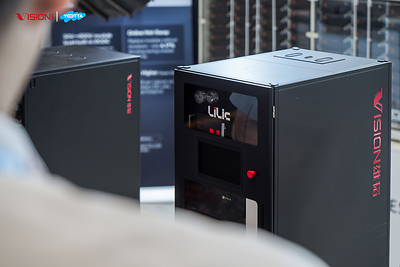
The DC architecture is important. In a conventional AC UPS path, energy may move through several conversion stages before it reaches a server:
AC utility → rectifier → battery DC → inverter AC → PDU → server PSU → low-voltage DC
An 800V DC design can reduce unnecessary conversions:
AC utility → regulated 800V DC bus → rack-level DC-DC conversion → compute load
Storage can support the protected bus through a bidirectional DC-DC converter. This avoids an AC-to-DC-to-AC-to-DC round trip for energy that is already stored as DC. Fewer conversion stages can reduce losses, heat, and equipment footprint, but only when the bus, converters, protection, and controls are engineered as an integrated system.
The approach also differs from pairing a flywheel with lithium batteries. A flywheel can respond rapidly and provide excellent short-duration ride-through, while the battery handles longer outages. That architecture remains useful, especially where mechanical systems, maintenance capabilities, and space are acceptable.
The LIC-plus-LFP model keeps both storage functions electrochemical and can place them closer to the rack-level DC bus. It may simplify some interconnections and avoid rotating equipment, but it introduces its own requirements: high-voltage DC protection, cell monitoring, thermal management, converter controls, and battery safety validation.
What to Specify Before You Buy
A hybrid storage proposal should not be evaluated by the phrase “hybrid” alone. Require measurable specifications for both timescales.
LIC specifications
Ask for:
- Continuous and peak power ratings in kW or MW
- Response time and control-loop latency
- Pulse duration supported, expressed in milliseconds and seconds
- Maximum pulse repetition rate
- Charge acceptance and discharge efficiency
- Operating temperature range
- Expected cycle life under the proposed duty profile
- Isolation, grounding, and DC fault-protection design
LFP specifications
Request:
- Total and usable capacity in kWh
- Continuous and peak discharge power
- Rated runtime at the actual rack load
- State-of-charge operating window
- Cycle-life data using the expected load profile
- Cell balancing and module replacement procedures
- Cell-, module-, and system-level monitoring
- Cooling design and thermal derating limits
Safety and commissioning evidence
For an indoor or near-load energy storage installation, request current UL 9540A testing evidence for the proposed configuration. UL 9540A is a thermal-runaway fire-propagation test method, not a generic statement that a chemistry is safe. The report should match the actual cell format, module design, enclosure, state of charge, cooling system, spacing, ventilation, and suppression strategy.
Also verify applicable UL 9540 certification, local code requirements, emergency disconnects, insulation monitoring, fault-clearing capability, and the authority having jurisdiction’s acceptance criteria.

The Hybrid Storage Roadmap
-
Capture the real load profile.
Do not size the system from average rack kW alone. Record step-load amplitude, rise time, pulse duration, repetition rate, and sustained outage demand. -
Separate power from energy requirements.
Specify the LIC system in kW and pulse duration. Specify the LFP system in usable kWh and required runtime. Treat them as separate design problems before combining them. -
Model the 800V DC architecture.
Map rectifiers, DC-DC converters, busbars, rack feeds, grounding, fault protection, and redundancy. Confirm whether the design supports A/B power paths or another fault-tolerant arrangement consistent with the facility’s Tier III or Tier IV objectives. -
Validate thermal and safety performance.
Review cooling capacity, cell-level monitoring, thermal propagation controls, emergency response, and UL 9540A evidence. Include the expected pulse duty cycle, not only a steady-state discharge test. -
Pilot on a defined AI cluster.
Begin with a controlled rack group or training pod. Compare battery temperature, voltage stability, pulse response, capacity retention, alarms, and maintenance data against a conventional LFP baseline.
Where the Cost Sits Today
A LIC-plus-LFP system will generally cost more upfront than a pure LFP bank of comparable sustained-energy capacity. It includes two storage technologies, additional controls, power-conversion equipment, monitoring, integration, and specialized commissioning.
The economic case depends on the duty cycle. If a pure LFP bank is being cycled aggressively by GPU transients, its lower purchase price may be offset by earlier replacement, additional cooling, oversized capacity, or reduced availability. A hybrid system may also reduce the need to overbuild the LFP bank simply to handle short-duration power spikes.
The correct comparison is therefore not battery price per kWh. Compare total cost of ownership: usable energy, peak power, cycle life, replacement schedule, cooling, floor space, serviceability, and the cost of an unplanned AI cluster shutdown.
Real-Time Solutions means designing for the complete operating profile. Ace Real Time Solutions can help evaluate UPS systems, batteries, DC distribution, monitoring, and facility-specific power protection requirements. Visit acerts.com to request a power audit or solution design, or review our guidance on AI power swings and power smoothing and 800V DC data center architecture.
FAQ
What is a hybrid lithium-ion capacitor and LFP backup system?
It is an energy-storage architecture that combines lithium-ion capacitors for rapid, repeated power pulses with lithium iron phosphate batteries for sustained energy delivery. The LIC bank manages transient power, while the LFP bank supports ride-through and shutdown requirements.
How does LiLic Sidecar support an 800V DC rack-level architecture?
Vision Group’s LiLic Sidecar is designed to connect to an 800V DC bus configured as ±400V. Its hybrid storage system supports transient smoothing and short-duration backup without requiring every event to pass through a conventional AC UPS conversion path. Vision specifies a five-module configuration capable of 1 MW discharge power and at least 60 seconds at a 1 MW load.
What should data center operators verify before specifying hybrid storage?
Operators should verify LIC peak-power and pulse-duration ratings, LFP usable kWh and runtime, cycle-life data under the actual AI load profile, cell-level monitoring, thermal management, DC fault protection, UL 9540 certification where applicable, and configuration-specific UL 9540A testing evidence.