

Eliminating the Battery Room: How DC Power Platforms Free Up Space for 1 GW Campuses
The traditional data center battery room is becoming a design constraint.
For decades, facility planners have treated batteries, chargers, distribution panels, disconnects, and monitoring equipment as separate systems assembled inside a dedicated room. That approach can work for a single facility. It becomes less attractive when a campus scales toward hundreds of megawatts: or even 1 GW: of capacity.
At that scale, every square foot has a financial and operational consequence. Space allocated to battery rooms cannot be used for switchgear, cooling equipment, electrical distribution, or future IT capacity. The answer is not simply to build larger rooms. It is to change the architecture.
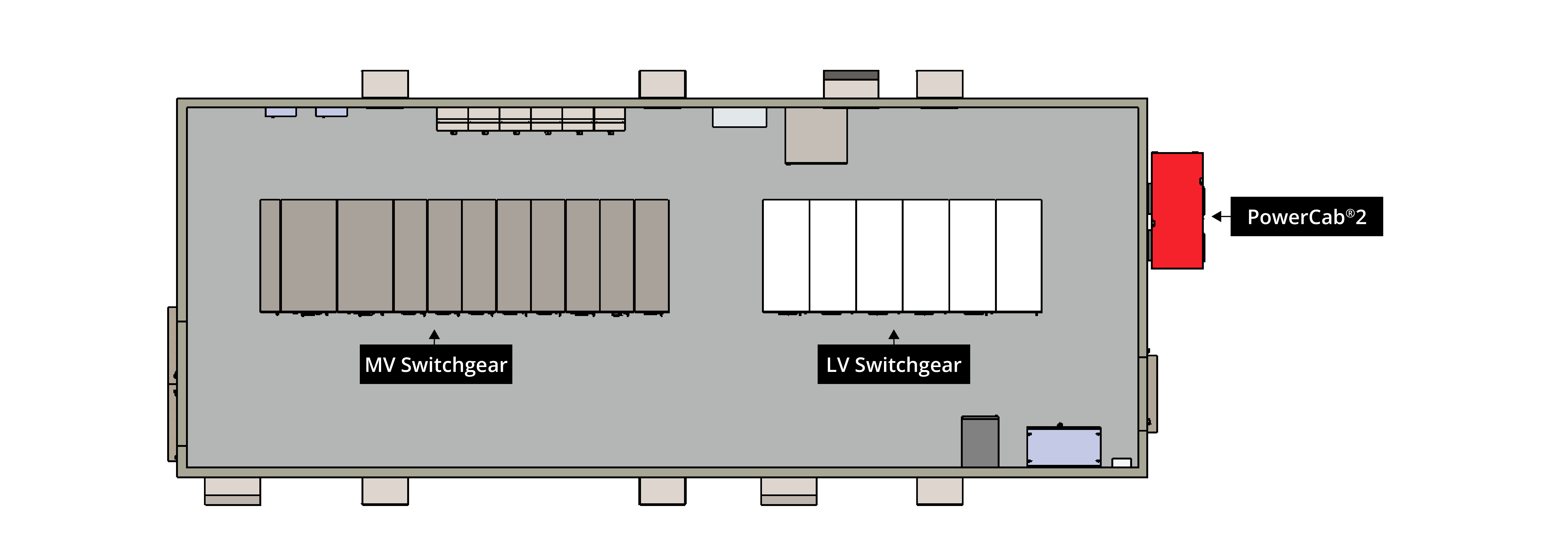
Modern integrated DC power platforms consolidate energy storage, power conversion, DC distribution, controls, and monitoring into factory-engineered cabinets. Installed near the power distribution center (PDC) or E-house, these systems can reduce footprint, simplify commissioning, and eliminate the need for a separate battery room in appropriate applications.

Why the Battery Room Model Is Under Pressure
AI infrastructure and hyperscale deployments are increasing power density and accelerating construction schedules. A campus may be divided into dozens or hundreds of PDCs and E-houses, each supporting switchgear, controls, protection systems, and critical distribution.
The conventional model adds several layers of complexity to every structure:
- Dedicated battery racks
- Separate chargers and rectifiers
- DC distribution panels
- Battery disconnects and protective devices
- Ventilation or environmental controls
- Spill containment, depending on chemistry
- Field-installed wiring and interconnections
- Separate monitoring and control components
Each component may be sourced, installed, tested, and maintained independently. That creates more interfaces for design errors, procurement delays, installation defects, and commissioning problems.
It also creates a space problem. A recent architecture analysis from Stored Energy Systems (SENS) states that an integrated DC platform can eliminate more than 300 square feet of dedicated battery-room space from a PDC or E-House. At a reported installed construction cost of approximately $850 per square foot, that represents about $255,000 of potential avoided space cost per structure.
For a 1 GW campus with approximately 80 to 300 PDCs or E-Houses, the projected campus-level savings can reach $20 million to $80 million. These figures are project estimates rather than universal benchmarks, but they illustrate why DC architecture deserves the same scrutiny as cooling, medium-voltage distribution, and white-space planning.
What an Integrated DC Power Platform Changes
An integrated platform does not merely place batteries in a smaller box. It changes where and how DC power is engineered.
A system such as SENS PowerCab2 combines power conversion, energy storage, DC distribution, controls, and optional monitoring into a factory-assembled enclosure. The system is configured for the application, tested before shipment, and delivered as a coordinated package rather than a collection of loose components.
The published specifications include:
- Configurable DC voltage from 24 to 240+ VDC
- Support for salt or VRLA battery chemistries
- Up to 32 two-pole DC breakers in a single 15-inch cabinet
- NEMA 1 indoor and NEMA 3R outdoor enclosure options
- Operating temperature range from approximately -40°C to 55°C
- UL listing for installations in the United States and Canada
- Optional battery monitoring, inverters, transfer switches, and expanded distribution
The manufacturer also reports that the platform can deliver up to 400 amps in a footprint substantially smaller than a conventional field-built system.
The important design principle is not one particular product. It is the consolidation of functions that are typically distributed across a room.
DC Platforms Are Not a Replacement for Every AC UPS
Architects should distinguish between two related but different power protection functions.
An AC UPS protects the critical IT load by conditioning incoming AC power and maintaining output during a utility disturbance. Depending on the topology, it may provide double-conversion efficiency, static bypass, battery autonomy, and generator ride-through for servers and networking equipment.
A DC power platform typically supports control power, station power, switchgear protection, breaker operation, automation, and other mission-critical electrical functions. It may keep the electrical system controllable while generators start or upstream sources are transferred.
In a resilient campus, both systems may be required. The goal is not to replace the AC UPS room with a DC cabinet. The goal is to avoid designing separate rooms for DC functions that can safely and reliably be integrated at the point of distribution.
This distinction matters for Tier III and Tier IV planning. Uptime Institute Tier standards address the availability and maintainability of the overall data center infrastructure. An integrated DC platform must still be coordinated with the site’s redundancy model, selective coordination study, fault-current analysis, maintenance bypass strategy, fire protection plan, and authority having jurisdiction (AHJ) requirements.
The Technical Benefits of Consolidated DC Distribution
1. More usable space inside the PDC or E-House
Eliminating a battery room can reduce the overall footprint of each electrical structure. SENS reports approximately 20% or more reduction in PDC or E-House footprint for certain designs.
That space can support additional switchgear sections, expanded cable termination areas, larger maintenance clearances, or future capacity. On a constrained campus, it may also reduce building volume, site civil work, and HVAC requirements.
2. Fewer field-installed interfaces
A factory-built platform can arrive with batteries, chargers, breakers, controls, and distribution already integrated. This reduces the number of field terminations and removes much of the coordination burden between electrical contractors, battery suppliers, controls integrators, and equipment manufacturers.
The result is not automatically risk-free. Engineers must still verify short-circuit ratings, protection settings, cable sizing, grounding, thermal performance, and compatibility with the broader electrical system. However, moving integration into a controlled manufacturing environment can make quality more repeatable.
3. Flexible battery chemistry selection
The right chemistry depends on the load profile, operating environment, maintenance model, safety requirements, and lifecycle strategy.
VRLA remains familiar and cost-effective for many indoor applications. Salt-based chemistries may offer advantages in challenging temperature ranges and applications where reduced ventilation or HVAC dependence is valuable. Lithium-ion may be appropriate for other UPS architectures, particularly where footprint and high energy density are priorities.
Battery selection should be based on a documented duty cycle, not energy density alone. Facility teams should evaluate autonomy, recharge time, expected ambient temperature, replacement logistics, monitoring capability, fire protection requirements, and end-of-life handling.
4. Better visibility into distributed assets
A gigawatt-scale campus may contain hundreds of distributed DC systems. Monitoring cannot remain dependent on periodic walk-throughs.
Integrated platforms should expose charger status, battery condition, alarms, breaker states, temperature, DC bus voltage, and event history to the facility’s monitoring environment. That data can feed DCIM, building management systems, computerized maintenance management systems, or AI-assisted analytics.
This is where modern Real-Time Solutions become valuable: not simply keeping equipment powered, but making the condition of every critical power asset visible before a fault becomes an outage.

The DC Power Platform Roadmap
Facility planners evaluating this architecture should take five practical steps.
-
Map every DC load by function and location.
Identify switchgear controls, protective relays, automation systems, breaker mechanisms, communications equipment, and other DC loads. Document nominal voltage, peak current, required autonomy, inrush characteristics, and acceptable interruption time. -
Standardize the PDC and E-House template.
Define repeatable cabinet layouts, voltage classes, breaker arrangements, cable entry points, monitoring interfaces, and maintenance clearances. Standardization is essential when deploying dozens of similar structures. -
Compare total installed footprint: not equipment price alone.
Include battery-room construction, ventilation, spill containment, racks, field wiring, testing, commissioning, engineering, and future maintenance access. A lower-cost component package may produce a higher installed cost if it creates more site labor and building area. -
Design redundancy at the DC architecture level.
Evaluate N+1, N+N, and dual-bus configurations against the site’s Tier III or Tier IV objectives. Confirm that a single charger, battery string, breaker, control circuit, or maintenance event cannot remove required protection from a critical electrical path. -
Connect monitoring to the operating model before procurement.
Establish alarm priorities, remote access requirements, cybersecurity controls, battery replacement thresholds, and escalation procedures. Monitoring is most useful when the operations team knows what action each alarm requires.
What This Means for Data Center Architects
The battery room has historically been treated as a fixed requirement. Integrated DC power platforms challenge that assumption.
For new campuses, the design opportunity is significant. DC power can be placed closer to the switchgear it supports, packaged into repeatable PDC designs, and deployed without dedicating a separate room to batteries and chargers. For expansions, compact cabinets may help increase capacity within an existing E-House footprint or reduce the size of a planned electrical building.
The approach also supports modular construction. Factory-assembled systems can be specified early, tested before delivery, and installed as part of a repeatable construction sequence. That supports faster deployment while reducing the number of custom field-built assemblies.
The right solution will depend on the site’s voltage levels, autonomy requirements, battery chemistry, environmental conditions, redundancy targets, and AHJ expectations. An integrated platform is not a shortcut around engineering. It is a way to move more engineering into the design and manufacturing phase, where it can be reviewed and controlled before equipment reaches the campus.
Build the Power Architecture Around Capacity, Not Tradition
At 1 GW scale, small architectural decisions multiply. A few hundred square feet saved at one PDC may not matter. The same reduction across 80, 150, or 300 structures can change the economics of the entire campus.
The modern approach is to evaluate DC power as a distributed, monitored, factory-engineered infrastructure layer: not as a collection of batteries stored in a room.
Ace Real Time Solutions helps data center and enterprise teams evaluate UPS systems, batteries, monitoring, distribution, and site-specific power protection requirements. Visit our enterprise request for quote page to discuss a campus architecture, or review our power protection services for design, installation, and lifecycle support.
For a broader battery and backup power review, explore our battery solutions. Request a technical consultation at acerts.com to determine whether a consolidated DC platform can reduce footprint, simplify deployment, and protect uptime across your next facility expansion.
Frequently Asked Questions
What is an integrated DC power platform?
An integrated DC power platform combines batteries, chargers or rectifiers, DC distribution, protection, controls, and monitoring in a factory-engineered enclosure. It is typically installed near switchgear, substations, PDCs, or E-Houses to provide reliable DC control and station power.
How does a DC power platform eliminate a dedicated battery room?
It places the batteries and associated DC power equipment inside a compact, enclosed cabinet or coordinated cabinet system. This can remove the need for separate battery racks, dedicated ventilation, spill containment, and a standalone battery room, subject to local codes, battery chemistry, and project requirements.
How much space can a DC power platform save on a 1 GW data center campus?
The exact amount depends on the campus layout and number of PDCs or E-Houses. Published project estimates indicate more than 300 square feet of battery-room space can be eliminated per structure, with potential campus-level savings of $20 million to $80 million across approximately 80 to 300 structures.