
CATL's Sodium-Ion Tener vs. Lithium: What the Battery Giant's Container Pivot Means for Backup Prices
CATL’s launch of the TENER Sodium Energy Storage System is more than another battery announcement. It is a signal that sodium-ion technology is moving from pilot projects into commercial procurement: and that stationary storage buyers may soon have a credible alternative to lithium iron phosphate (LFP).
CATL says its sodium-ion TENER platform will begin deliveries in China in September 2026, with international deliveries scheduled to begin in June 2027. The company also projects 1 GWh of cumulative sodium-ion shipments during 2026. Those dates matter to procurement managers because they establish a near-term decision point: whether to continue specifying LFP as the default chemistry or begin evaluating sodium-ion for selected applications.
The immediate impact will not be the replacement of lithium across every UPS or battery energy storage system (BESS). Sodium-ion has lower energy density and a shorter commercial track record. However, CATL’s purpose-built container architecture, claimed 15,000-cycle life, wide-temperature performance, and compatibility with existing system designs could put pressure on lithium pricing and reshape how buyers evaluate total cost of ownership.
What CATL Actually Announced
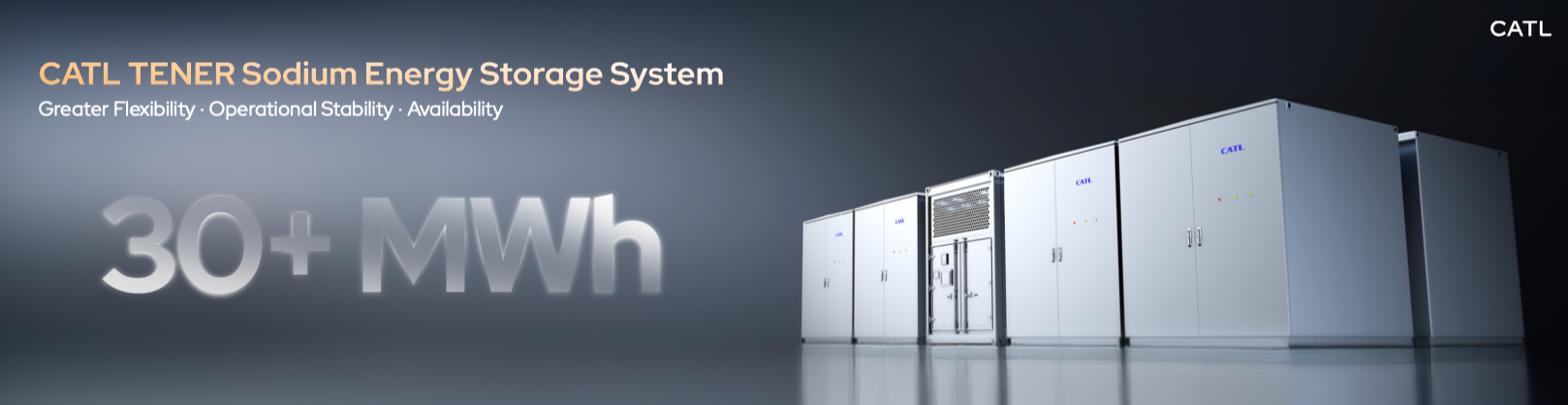
CATL’s official announcement describes TENER Sodium as a modular, utility-scale energy storage platform with more than 30 MWh of rated capacity per module.
The architecture uses:
- Approximately 42-ton modular battery units
- Eight battery units and two cooling units per large module
- Approximately 34 modules for a 1 GWh project
- Decoupled energy and power blocks
- Configurable discharge durations of 1, 2, 4, 6, or 8 hours
- Compatibility with major power conversion system (PCS) products
- A dedicated bidirectional DC voltage regulation system
- Liquid cooling and an energy management system designed for sodium-ion voltage characteristics
CATL also states that a sodium-ion and lithium-ion configuration can share the same physical platform. That is important for developers and facility owners seeking to preserve design flexibility as battery chemistry changes.
The company is also positioning sodium-ion as a response to three procurement risks: lithium supply concentration, climate-related performance variation, and long-term degradation.
Sodium-Ion vs. Lithium: The Technical Comparison
The most important procurement mistake would be treating sodium-ion as a simple one-for-one replacement for LFP. The two chemistries have different strengths.
Energy density and footprint
Lithium-ion generally delivers higher energy density. That advantage matters when land, container count, transportation, or interconnection space is limited.
CATL’s earlier lithium-based TENER system offered 6.25 MWh in a 20-foot container, while reporting on the sodium-ion container product identifies a roughly 3.07 MWh system in a 20-foot enclosure. That comparison is not a complete measure of system performance because product generations, operating limits, and configurations differ. It does show why sodium-ion may require more physical space for the same stored energy in some projects.
For a constrained urban site or a data center campus where every square foot has value, LFP may remain the stronger choice. For a utility, industrial site, or campus with available land, the footprint penalty may be easier to absorb.
Cycle life
CATL reports up to 15,000 cycles to 70% state of health at approximately 25°C and more than 10,000 cycles at 45°C for TENER Sodium.
Those figures are significant for projects that cycle daily. They may reduce augmentation requirements, replacement events, and the risk that a storage asset loses economic value before the end of its contracted life.
Cycle-life claims must still be evaluated against the operating profile in the contract. Buyers should confirm:
- Depth-of-discharge assumptions
- Charge and discharge C-rates
- End-of-life capacity guarantees
- Temperature conditions
- Warranty exclusions
- Augmentation responsibilities
- Availability and round-trip efficiency guarantees
A 15,000-cycle headline number is useful, but it is not a substitute for a complete warranty schedule.
Temperature performance and thermal management
Sodium-ion’s strongest differentiator may be its performance in challenging climates.
CATL states that TENER Sodium can retain more than 92% of capacity at −20°C without additional insulation or forced heating. It also reports more than 10,000 cycles at 45°C.
This could reduce thermal management requirements in outdoor installations, cold-climate facilities, and locations where HVAC energy consumption is a major operating cost. CATL says its TENER Sodium design reduces auxiliary power consumption to approximately 1%, compared with an industry average of approximately 2%.
That difference is not trivial at a 1 GWh site. Lower cooling and auxiliary loads can improve usable output, reduce parasitic consumption, and improve the project’s levelized cost of storage.
However, thermal management does not disappear. Sodium-ion systems still require engineered cooling, ventilation, controls, fire detection, and emergency response systems. Facility managers should evaluate the complete enclosure design rather than assuming chemistry alone eliminates safety or HVAC requirements.
Safety and operating flexibility
CATL describes sodium-ion as having a higher overcharge tolerance and lower gas generation than comparable lithium systems. The company also reports a lower surface temperature during thermal runaway conditions.
These claims may support easier permitting or improved risk management, but they should be validated through independent testing, local code review, and the project’s authority having jurisdiction. Procurement teams should request test reports, certification records, fire-protection documentation, and incident-response procedures before assigning a safety premium to any chemistry.
Why the 2027 Price Signal Matters
CATL has not published a universal $/kWh price for TENER Sodium. Any forecast that assigns a precise 2027 price without a project quotation would be speculative.
The more defensible conclusion is that sodium-ion is likely to affect pricing through competition, supply-chain diversification, and total cost of ownership.
1. Sodium may reduce raw-material exposure
Sodium is abundant and widely distributed compared with lithium. That does not mean the complete battery system will automatically cost less. Cells also include active materials, current collectors, manufacturing equipment, electronics, enclosures, cooling systems, transportation, and commissioning services.
Still, a viable sodium-ion supply chain gives manufacturers another way to manage lithium price volatility. As volumes increase, that option should improve negotiating leverage for buyers.
2. Early systems may be cost-competitive, not dramatically cheaper
New technologies often carry initial engineering, qualification, and supply-chain costs. In 2027, sodium-ion systems may reach price parity with comparable LFP systems before achieving a clear upfront discount.
Procurement managers should therefore compare:
- Delivered system cost
- Installation and civil-work requirements
- PCS and transformer costs
- HVAC and auxiliary energy consumption
- Warranty terms
- Expected augmentation
- Insurance and permitting costs
- Replacement and recycling obligations
A sodium-ion system with similar upfront cost may still produce a lower lifetime cost if it cycles more frequently, performs better in extreme temperatures, or requires less auxiliary power.
3. Lithium prices will face a new competitive benchmark
The most important effect may be on negotiations for LFP systems. Once sodium-ion becomes commercially available from a major supplier, buyers can request chemistry-neutral bids and ask vendors to explain the lifetime value of their proposed technology.
That creates a stronger procurement position even when LFP remains the selected chemistry.
What This Means for UPS Battery Buyers
Large container BESS and mission-critical UPS systems are related, but they are not interchangeable.
A data center UPS must meet strict requirements for instantaneous transfer, power quality, redundancy, battery monitoring, bypass operation, and runtime. A utility-scale BESS is usually optimized for energy shifting, frequency regulation, capacity support, or grid services.
For critical IT loads, procurement teams should not replace an established UPS battery architecture solely because a sodium-ion BESS offers an attractive cycle-life claim. The chemistry must be qualified for the UPS topology, DC bus voltage, battery management system, protection scheme, maintenance process, and applicable standards.
Sodium-ion may become relevant for:
- Long-duration facility backup
- Microgrids
- Renewable integration
- Campus peak shaving
- Utility-interactive data center systems
- Outdoor telecom and edge infrastructure
- Battery systems where cold-weather performance is important
For rack-level or centralized UPS deployments, mature lead-acid and lithium-ion products may remain easier to source and service in the near term. Buyers can review current battery options through Ace Real Time Solutions’ battery collection and request a chemistry-neutral recommendation based on runtime, load, redundancy, and operating environment.
The Sodium-Ion Procurement Roadma
Facility managers and energy analysts can prepare for the 2027 market with five practical steps:
-
Separate the application from the chemistry. Define whether the system is serving UPS ride-through, long-duration backup, peak shaving, renewable firming, or grid services. Each use case may produce a different winner.
-
Require a full lifecycle model. Compare delivered cost, auxiliary power, cooling, augmentation, degradation, maintenance, insurance, and end-of-life costs: not only the battery’s initial $/kWh.
-
Request chemistry-neutral bids. Ask suppliers to price LFP and sodium-ion alternatives using the same capacity, power, duration, availability, and warranty requirements.
-
Validate operating claims. Request independent test data for cycle life, thermal performance, round-trip efficiency, safety, and end-of-life capacity under the conditions your site will actually experience.
-
Protect design flexibility. Specify modular enclosures, PCS compatibility, monitoring interfaces, and expansion paths that do not lock the project into one chemistry before final procurement.
Ace Real Time Solutions can help organizations evaluate backup batteries, UPS systems, monitoring, and broader power protection requirements through a site-specific design process. Visit acerts.com, review our enterprise procurement resources, or request a quote and solution design.
The Bottom Line
CATL’s TENER Sodium launch does not make lithium obsolete. It does make the stationary storage market more competitive.
LFP will likely remain the default for many projects because of its energy density, supply-chain maturity, established warranties, and extensive operating history. Sodium-ion becomes compelling where temperature resilience, cycle life, supply-chain diversification, safety margins, and long-term operating cost matter more than maximum energy density.
For 2027 procurement, the most realistic expectation is not a universal collapse in battery prices. It is greater price competition, more chemistry choices, and a stronger shift from upfront cost to whole-life value.
That is the foundation of Real-Time Solutions: selecting the right power protection architecture for the actual load, operating environment, and continuity objective.
Frequently Asked Questions
What is CATL’s TENER Sodium system?
CATL’s TENER Sodium is a modular, containerized sodium-ion battery energy storage system designed for utility-scale and large commercial applications. CATL reports more than 30 MWh of capacity per large module, flexible 1- to 8-hour configurations, and international deliveries beginning in June 2027.
How does sodium-ion compare with lithium-ion for stationary storage?
Sodium-ion generally offers lower energy density but may provide advantages in raw-material availability, cold-temperature performance, cycle life, and thermal management. Lithium-ion remains more mature and compact for many applications. The best choice depends on site footprint, operating temperature, cycling frequency, warranty terms, and total cost of ownership.
Will sodium-ion make UPS batteries cheaper in 2027?
Sodium-ion may increase competition and reduce supply-chain exposure, but public sources do not establish a universal 2027 price. For UPS buyers, pricing will depend on system size, runtime, power electronics, certification, installation, service, and warranty requirements. A power audit is necessary before selecting a battery chemistry.