

7 Mistakes You’re Making with Arc Flash Labels (and How to Fix Them)
As we move deeper into 2026, the landscape of power protection and facility management has shifted from simply "keeping the lights on" to managing unprecedented power densities. With the explosion of AI-driven workloads and the massive deployment of high-performance computing clusters, the electrical infrastructure supporting our data centers is under more stress than ever. This isn’t just a performance challenge; it’s a safety imperative. In an era where a single rack can pull upwards of 50kW to 100kW, the margin for error in electrical safety, specifically regarding arc flash protection, has effectively vanished.
The "State of the Union" for modern power infrastructure is one of complexity and high stakes. We are seeing a massive push toward liquid cooling and hyper-dense power distribution, which often leads to frequent equipment modifications. Unfortunately, safety compliance, particularly arc flash labeling, often trails behind these rapid hardware deployments. It’s no longer enough to have a sticker on a panel; that sticker must be accurate, up-to-date, and reflective of the current system configuration to ensure that facility managers and technicians aren't walking into a high-energy hazard blindfolded.
Why Now: The Collision of Latency and Safety
Why is arc flash labeling suddenly the most critical item on your 2026 checklist? The answer lies in the tension between latency and redundancy. To meet the demands of real-time AI processing, we are pushing power closer to the edge and increasing the complexity of our redundancy schemes (N+1, 2N, etc.). Every time you add a new Vertiv UPS system or a bank of Dakota Lithium batteries to improve resilience, you change the impedance and potential fault current of your system.
The status quo of "we did a study five years ago" is failing because the thermal management demands and power draws of 2026 hardware bear little resemblance to the loads of 2021. If your labels aren't updated to reflect these changes, your PPE (Personal Protective Equipment) selections will be wrong, and in the event of an arc flash, the results could be catastrophic. Real-Time Solutions require real-time safety data.

Mistake 1: Confusing Working Distance with Authorization
One of the most common errors I see in the field is a fundamental misunderstanding of the "Working Distance" listed on the label. Often, a label will specify a working distance of 18 or 24 inches. Technicians sometimes mistake this as a "safe zone" or, conversely, as a blanket authorization to perform energized work at that distance.
The Fix: Understand that the working distance is a mathematical reference point used to calculate incident energy, essentially the distance from the hazard to the worker's head and torso. It does not authorize hot work. Before any cover is removed or any energized component is touched, a task-specific hazard analysis must be performed. Your arc flash label is a data point, not a work permit.
Mistake 2: Placing Labels on Upstream Equipment for Downstream Hazards
In the rush to complete a project, labels often end up on the wrong equipment. I’ve walked into facilities where the label for a downstream distribution panel is slapped onto the upstream CyberPower switchgear. This is dangerous because the incident energy levels can vary wildly between different points in the power chain.
The Fix: Follow NFPA 70E Article 130.5(H) religiously. Labels must be placed specifically on the equipment they describe. Each piece of gear, from the main service entrance down to the smallest disconnect, needs its own specific data. If you are updating your APC by Schneider Electric infrastructure, ensure the labels move with the logic of the power flow, not just where there’s an empty spot on the cabinet.
Mistake 3: Using Outdated PPE Categories (The HRC Trap)
The industry has moved away from the old Hazard Risk Category (HRC) 0-4 numbering system in favor of specific incident energy values or simplified PPE Categories. Yet, many facilities are still using labels that look like they belong in 2015. Mixing old HRC terminology with new PPE requirements leads to confusion and, ultimately, the wrong gear being worn.
The Fix: Align your labeling with the current 2024/2026 standards. Your labels should display either the calculated incident energy (in cal/cm²) or the specific PPE Category, but never both on the same label, as this creates conflicting instructions. Standardizing this across your entire facility ensures that whether a technician is working on a Minuteman UPS or a high-voltage transformer, they know exactly what level of protection is required.
Mistake 4: Missing Labels on "Likely to be Energized" Gear
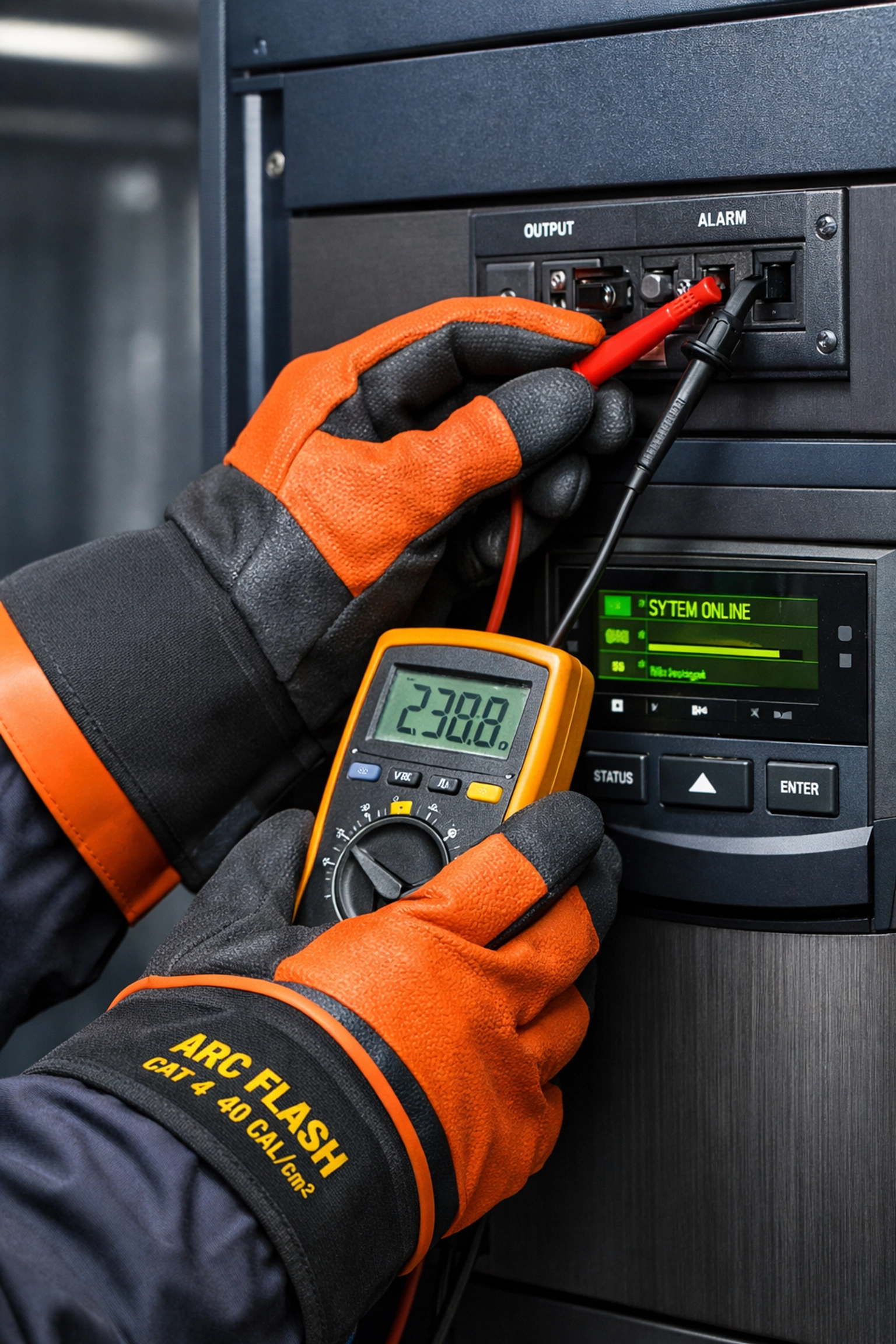
If it requires examination, adjustment, or maintenance while energized, it must have a label. I frequently see facilities that label their primary switchgear but ignore the smaller sub-panels or the inverter-chargers used in their backup systems.
The Fix: Conduct a comprehensive audit. Any piece of electrical equipment that might be serviced while live needs a label that includes the nominal voltage, the arc flash boundary, and the required PPE. Don't assume that "small" equipment doesn't pack a punch; high-density batteries can deliver massive short-circuit currents that produce significant arc flashes.
Mistake 5: Ignoring Environmental Degradation (Thermal Management)
Data centers are hot. High-density AI racks create significant thermal stress, not just on the servers, but on the labels themselves. Cheap, paper-based, or poorly adhesive labels will peel, fade, or become brittle over time. If a technician can’t read the arc flash boundary because the ink has faded from the heat, the label is useless.
The Fix: Use industrial-grade, UV-resistant, and high-temperature adhesive labels. Your power protection gear, like your batteries, is designed to last for years. Your safety labeling should be just as durable. Implement a visual inspection of labels during every semi-annual maintenance window.
Mistake 6: The "Five-Year Rule" is the Floor, Not the Ceiling
The NFPA 70E requires an arc flash study update every five years. However, many managers treat this as a "set it and forget it" task. In the modern data center, a lot can change in five years. Adding a new utility feed, changing out fuses for circuit breakers, or upgrading your UPS efficiency ratings can all drastically change your incident energy levels.
The Fix: Update your study whenever a major change occurs. If you've increased your MW per rack or added a new Tier III redundant power path, you need to recalculate. Waiting for the five-year mark is a gamble you shouldn't take with your team’s safety.
Mistake 7: Failing to Account for Utility Fault Current Changes
This is the mistake most people miss. You might not have changed a single thing in your building, but the utility company might have upgraded their transformer down the street or changed the grid configuration. If the available short-circuit current from the utility increases, your arc flash calculations, and your labels, are now wrong.
The Fix: When you perform your periodic power audit, contact your utility provider to verify the current short-circuit current ratings (SCCR). This data is the "source of truth" for your entire calculation. Real-Time Solutions means knowing what's coming off the grid today, not five years ago.

The Arc Flash Compliance Roadmap
Ensuring your facility is safe and compliant doesn't have to be an overwhelming task. Follow this 5-step roadmap to bring your labeling into 2026 standards:
- Baseline Audit: Walk your floor and identify every piece of equipment that is unlabeled or has a label older than three years. Use this as your "To-Do" list.
- Verify Data Points: Ensure your study includes the latest Short Circuit Current Rating (SCCR) from your utility and accounts for all current UPS and battery configurations.
- Standardize Your PPE Logic: Decide on a single method for your facility (either Incident Energy or PPE Category) and stick to it across all labels to eliminate technician confusion.
- Invest in Durability: Print labels on high-tack, heat-resistant vinyl. In high-density environments, thermal management is key; don't let a $5 sticker be the weak link in your $5M infrastructure.
- Establish a "Change Trigger": Create a policy that any equipment upgrade, be it a new IT rack or a cooling system, automatically triggers a review of the arc flash study.
Technical Specifications and Standards
To maintain a Tier III or Tier IV data center standard, precision is everything. When calculating incident energy, we aren't just looking at voltage; we are looking at the clearing time of the protective devices. If you are using high-efficiency UPS systems from brands like Vertiv or APC, their internal bypass and fault-clearing characteristics must be factored into your coordination study.
Modern "Real-Time Solutions" often utilize AI-driven monitoring to track power quality and load changes. These tools can provide the exact data needed for your next arc flash update, ensuring that your safety protocols are as smart as your infrastructure.
FAQ
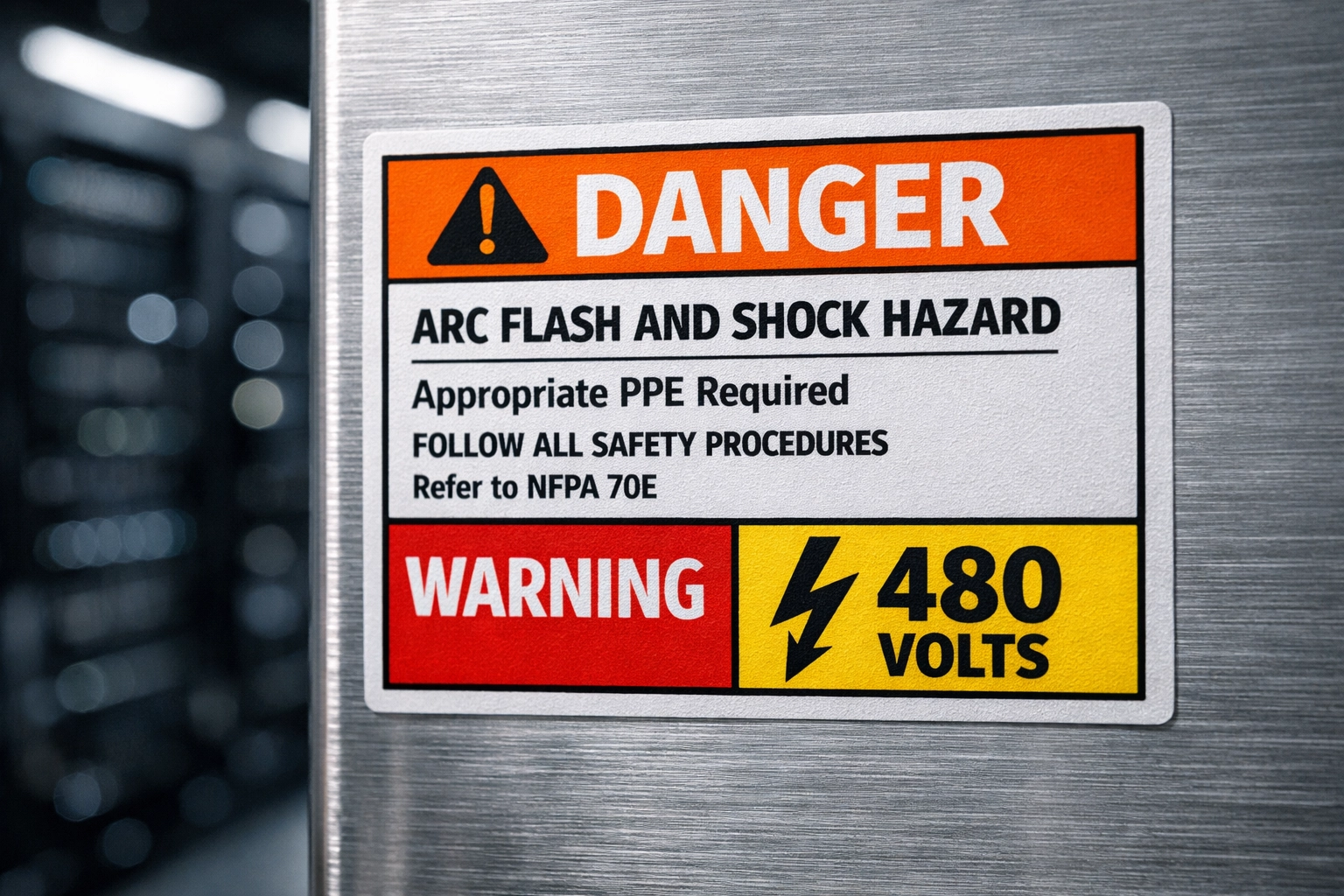
What is the minimum information required on an arc flash label in 2026? According to the latest standards, a label must include the nominal system voltage, the arc flash boundary, and at least one of the following: available incident energy and the corresponding working distance, or the specific PPE category for the equipment.
How does changing a fuse to a circuit breaker affect my arc flash labels? Circuit breakers and fuses have different "clearing times", the time it takes to interrupt a fault. Because incident energy is a function of time and current, changing the type of protective device will almost certainly change the incident energy level, making your current label inaccurate.
Do I need arc flash labels for DC power systems like battery arrays? Yes. While arc flash was historically focused on AC systems, modern standards (NFPA 70E) provide clear guidance on DC arc flash hazards. With the rise of high-capacity lithium battery storage, DC arc flash labeling is mandatory for any energized work.
Ready to Secure Your Infrastructure?
Don't leave your facility's safety to a five-year-old sticker. At Ace Real Time Solutions, we specialize in the intersection of high-performance power protection and rigorous safety compliance. Whether you are scaling up for AI or managing a distributed edge network, our team can help you navigate the complexities of modern electrical standards.
Click here to request a comprehensive Power Audit or download our latest Technical Spec Sheet for 2026-compliant power protection solutions. Let’s ensure your uptime and your safety are both unshakeable.